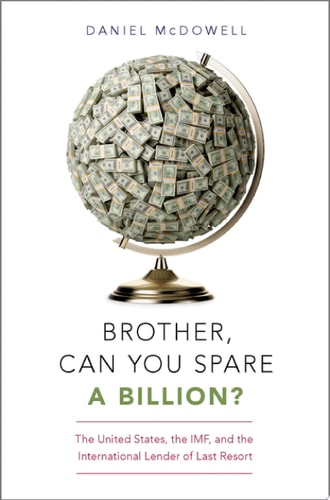
Brother, Can You Spare a Billion?
0
0
As an Amazon Associate and affiliate partner, Menrva Books earns from qualifying purchases. Learn more
Author Description
Conventional Wisdom Says That The International Monetary Fund (imf) Functions As The De Facto International Lender Of Last Resort (illr) For The Global Financial System. However, That Premise Is Incomplete. Brother, Can You Spare A Billion? Explores How The U.s. Has For Decades Regularly Complemented The Fund's Illr Role By Selectively Providing Billions Of Dollars In Emergency Loans To Foreign Economies In Crisis. Why Would The U.s. Ever Put National Financial Resources At Risk To Bail Out Foreign Countries? Mcdowell Argues That The U.s. Has Been Compelled To Provide Such Rescues Unilaterally When It Believes The Imf's Multilateral Response Is Too Slow Or Too Small To Protect Vital U.s. Economic Interests. Through A Combination Of Historical Case Studies And Statistical Analysis, Mcdowell Uncovers The Defensive Motives Behind U.s. Decisions To Provide Global Liquidity From The 1960s Through The 2008 Global Financial Crisis. Moving Beyond Conventional Wisdom, This Book Paints A Complete Picture Of How International Financial Crises Have Been Managed And Highlights The Unique Role The U.s. Has Played In Stabilizing The World Economy In Troubled Times.
Menrva's Summary
THE THESIS
This book investigates why the United States frequently bypasses the International Monetary Fund to provide unilateral emergency financial bailouts to foreign nations. Daniel McDowell, a political science scholar, utilizes a framework of national interest and economic security to argue that these interventions are calculated defensive measures. By analyzing decades of financial data and historical policy decisions, he demonstrates that the U.S. acts as a supplementary lender of last resort when it perceives multilateral institutions as insufficient to protect its own economic stability.
THE SCOPE MAP
What You Will Find
- Analysis of U.S. emergency loan policies from the 1960s through the 2008 global financial crisis.
- A comparative framework between multilateral IMF responses and unilateral U.S. financial interventions.
- Statistical data regarding global liquidity provision and historical case studies of specific country bailouts.
Scope Limits
- The analysis focuses primarily on U.S. unilateral actions and does not provide an exhaustive history of the IMF's internal governance structures.
- The text does not cover post-2008 financial crisis developments or the most recent shifts in global monetary policy.
THE AUTHORITY PERSPECTIVE
Experts in international political economy identify this text as a significant contribution to understanding the intersection of domestic policy and global financial stability. Readers frequently note the academic rigor of the prose and the clarity with which the author connects historical events to modern economic strategy.
Page Count:
256
Publication Date:
2016-01-01
Publisher:
Oxford University Press
ISBN-10:
0190605774
ISBN-13:
9780190605773
Economics
History
Finance
Global Policy
International relations
Community Tags
Similar Books