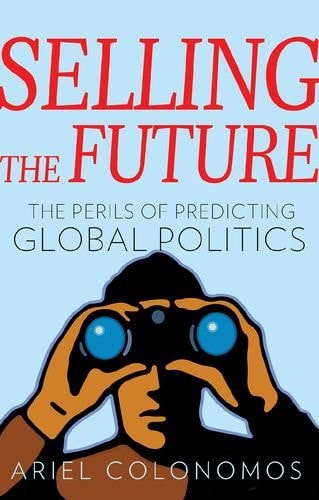
Selling the Future: The Perils of Predicting Global Politics
0
0
As an Amazon Associate and affiliate partner, Menrva Books earns from qualifying purchases. Learn more
Author Description
In an age of uncertainty, those who can anticipate revolution, the outbreak of wars, or which states might default are much in demand. The marketplace of ideas about the future is huge, and includes 'wonks", scholars and pundits who produce scenarios, predictions and ratings. The more opaque the future seems to be, so the relation between knowledge and power intensifies, above all the nexus between those who sell their expertise and those who consume it.In his investigation of the paradoxes of forecasting, Ariel Colonomos interrogates today's knowledge factories to reveal how our futures are shaped by social scientists, think tanks and rating agencies. He explains why conservative and linear predictions prevail, and why the future, especially when linked to national interest, reflects a systematic search for stability. The notion of a globalized world whose main characteristic is speed, and where predictions have accelerating, self-fulfilling effects, is obsolete. Those who are supposed to know, reassure those who are supposed to act. Their preferences converge, and thus the industry of the future has a decelerating effect on world politics. These 'lords of knowledge' reinforce pre-existing beliefs, create expectations about the future, while obstructing its vision when -- inevitably -- it diverges from its orderly path.
Menrva's Summary
THE THESIS
This book investigates the paradoxes of political forecasting and the influence of knowledge producers on global stability. Ariel Colonomos, a researcher in international studies, examines the nexus between experts—such as think tanks, rating agencies, and social scientists—and the political actors who consume their predictions. He argues that the forecasting industry systematically favors linear, conservative outcomes that reinforce existing power structures rather than accurately anticipating change.
THE SCOPE MAP
What You Will Find
- Analysis of the political economy of knowledge production
- Examination of the relationship between expert forecasting and national interest
- Critique of the 'self-fulfilling' nature of political predictions
- Investigation into how 'lords of knowledge' influence policy-making
Scope Limits
- Does not provide a manual for improving predictive accuracy
- Focuses primarily on the systemic biases of institutional forecasting rather than individual psychological biases
THE AUTHORITY PERSPECTIVE
Scholars in international relations frequently cite this work for its critical examination of how expert knowledge shapes political reality. Readers often note the academic density of the prose, which is well-suited for students and professionals interested in the sociology of political science.
Page Count:
225
Publication Date:
2016-08-15
Publisher:
Oxford University Press
ISBN-10:
019060364X
ISBN-13:
9780190603649
Non-Fiction
Globalization
Sociology
International relations
Forecasting
Community Tags
Similar Books