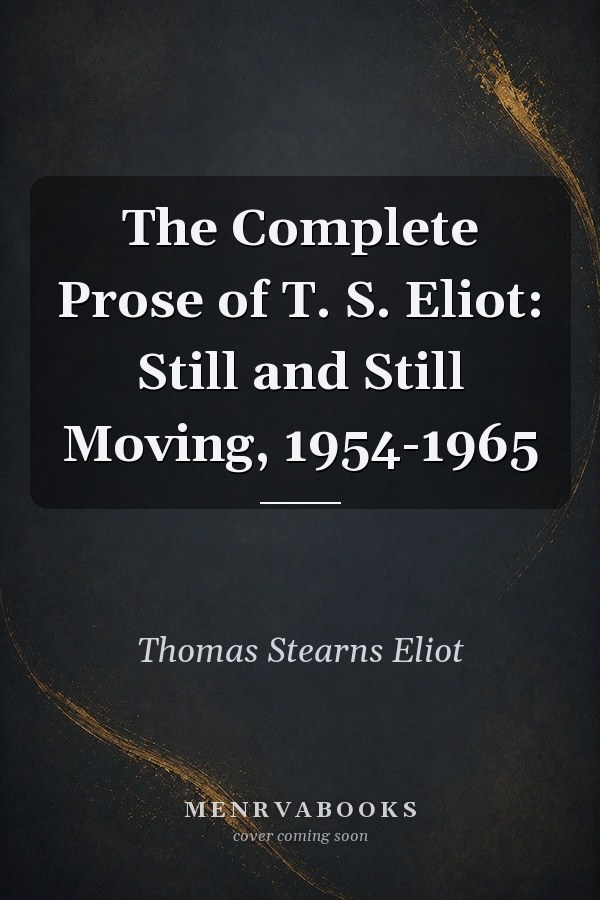
The Complete Prose of T. S. Eliot: Still and Still Moving, 1954-1965
0
0
As an Amazon Associate and affiliate partner, Menrva Books earns from qualifying purchases. Learn more
Author Description
T.S. Eliot entered the last decade of his monumental career with no lack of energy in pursuing his dramatic and critical writing, completing his final play, The Elder Statesman, and publishing a versatile sequence of canonical essays, including "Goethe as the Sage," "The Politics of Literature," "The Frontiers of Criticism," and "To Criticize the Critic." All the while he was fully engaged in a variety of critical genres, including tributes to international writers and artists in celebration of their careers, such as Picasso, Sylvia Beach, and Paul Claudel; he wrote twelve obituaries for close friends in his literary and publishing life, from Harriet Weaver and Geoffrey Faber to Wyndham Lewis and Louis MacNeice. As a public figure in high demand, he maintained a rigorous schedule of lectures and addresses for English, European, and American audiences; he wrote numerous public letters to editors of papers and journals on literary, church, and civic matters, from cuts to the BBC's Third Programme to the language of the New English Bible. Much critical energy was invested in writing introductions and prefaces to editions and books on French symbolism, Ezra Pound, James Joyce, Katherine Mansfield, Paul Valery, David Jones, John Davidson, and Hugo von Hofmannsthal. After reading, criticizing, and meditating on the writing of an English poet over the whole of his career, Eliot made him the subject of his final major essay, "George Herbert": "In his poems we can find ample evidence of his spiritual struggles, of self-examination and self-criticism, and of the cost at which he acquired godliness."
Menrva's Summary
THE THESIS
This volume collects the final decade of T. S. Eliot's extensive prose output, showcasing his continued engagement with literature, criticism, and public life. Eliot, in his later years, remained a prolific writer, completing his last play, The Elder Statesman, and producing significant essays on figures like Goethe and George Herbert. He also contributed tributes to artists, wrote obituaries for friends, delivered lectures internationally, and penned public letters on various civic and literary matters. The collection further includes his introductions to works on French symbolism and other prominent writers, demonstrating the breadth of his critical and public intellectual activities during this period.
THE SCOPE MAP
- Collection of essays from 1954-1965, including "Goethe as the Sage," "The Politics of Literature," "The Frontiers of Criticism," and "To Criticize the Critic."
- Includes tributes to international writers and artists such as Picasso, Sylvia Beach, and Paul Claudel.
- Features twelve obituaries for notable literary and publishing figures like Wyndham Lewis and Louis MacNeice.
- Contains records of lectures and addresses delivered to English, European, and American audiences.
- Includes public letters to editors on literary, church, and civic topics.
- Features introductions and prefaces to editions and books on French symbolism, Ezra Pound, James Joyce, and others.
- Culminates with Eliot's final major essay on the poet George Herbert.
THE AUTHORITY PERSPECTIVE
This collection offers a comprehensive look at T. S. Eliot's later prose, a period marked by continued intellectual vitality and engagement with the literary world. The inclusion of his final essays, tributes, and public writings provides valuable insight into his critical perspectives and his role as a public intellectual. Readers and scholars can expect to find a rich array of his thoughts on poetry, art, and society during the last decade of his life. The volume serves as a significant resource for understanding the full scope of Eliot's contribution to 20th-century literature and thought.
Page Count:
688
Publication Date:
2019-01-01
Publisher:
Johns Hopkins University Press
ISBN-10:
1421418959
ISBN-13:
9781421418957
Biography
Poetry
Literary Fiction
Non-Fiction
Literary Criticism
Essays
Community Tags
Similar Books