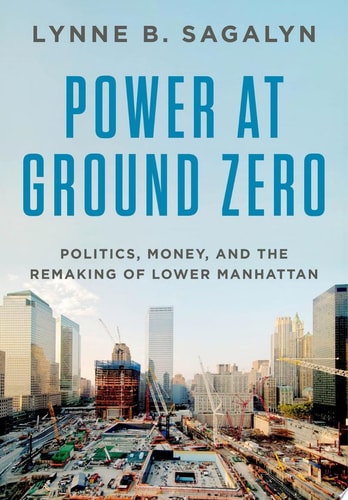
Power at Ground Zero: Politics, Money, and the Remaking of Lower Manhattan
0
0
As an Amazon Associate and affiliate partner, Menrva Books earns from qualifying purchases. Learn more
Author Description
The destruction of the World Trade Center complex on 9/11 set in motion a chain of events that fundamentally transformed both the United States and the wider world. War has raged in the Middle East for a decade and a half, and Americans have become accustomed to surveillance, enhanced security, and periodic terrorist attacks. But the symbolic locus of the post-9/11 world has always been "Ground Zero"--the sixteen acres in Manhattan's financial district where the twin towers collapsed. While idealism dominated in the initial rebuilding phase, interest-group trench warfare soon ensued. Myriad battles involving all of the interests with a stake in that space-real estate interests, victims' families, politicians, the Port Authority of New York and New Jersey, the federal government, community groups, architectural firms, and a panoply of ambitious entrepreneurs grasping for pieces of the pie-raged for over a decade, and nearly fifteen years later there are still loose ends that need resolution. In Power at Ground Zero, Lynne Sagalyn offers the definitive account of one of the greatest reconstruction projects in modern world history. Sagalyn is America's most eminent scholar of major urban reconstruction projects, and this is the culmination of over a decade of research. Both epic in scope and granular in detail, this is at base a classic New York story. Sagalyn has an extraordinary command over all of the actors and moving parts involved in the drama: the long parade of New York and New Jersey governors involved in the project, Mayor Michael Bloomberg, various Port Authority leaders, the ubiquitous real estate magnate Larry Silverstein, and architectural superstars like Santiago Calatrava and Daniel Libeskind. As she shows, political competition at the local, state, regional, and federal level along with vast sums of money drove every aspect of the planning process. But the reconstruction project was always about more than complex real estate deals and jockeying among l
Menrva's Summary
THE THESIS
This book investigates the complex intersection of political maneuvering, financial interests, and urban planning that defined the reconstruction of the World Trade Center site following the events of September 11, 2001. Lynne B. Sagalyn, a scholar of urban development, utilizes over a decade of research to document the competing agendas of stakeholders ranging from government agencies and real estate developers to victims' families and architectural firms. The work argues that the rebuilding process was not merely a construction project, but a high-stakes arena where regional power dynamics and economic pressures dictated the physical and symbolic transformation of Lower Manhattan.
THE SCOPE MAP
What You Will Find
- A detailed chronology of the fifteen-year reconstruction process at the sixteen-acre World Trade Center site.
- Analysis of the decision-making frameworks used by the Port Authority, city officials, and private developers.
- Examination of the influence of political competition at local, state, and federal levels on urban design.
Scope Limits
- The text focuses primarily on the administrative and political mechanics of the reconstruction rather than the personal narratives of the victims or the architectural aesthetics in isolation.
THE AUTHORITY PERSPECTIVE
Experts recognize this work as a comprehensive and authoritative account of modern urban reconstruction, noting its meticulous attention to the bureaucratic and financial complexities involved. Readers frequently highlight the density of the prose, which provides a granular look at the institutional challenges inherent in large-scale public-private development projects.
Page Count:
921
Publication Date:
2016-01-01
Publisher:
Oxford University Press
ISBN-10:
0190607041
ISBN-13:
9780190607043
Architecture
History
United States
Professional Career & Trade
Land Use
New York
Public Policy
urban planning
DESIGN General
Community Tags
Similar Books