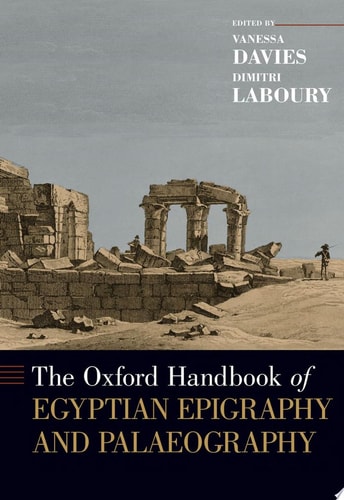
The Oxford Handbook Of Egyptian Epigraphy And Palaeography
0
0
As an Amazon Associate and affiliate partner, Menrva Books earns from qualifying purchases. Learn more
Author Description
The Unique Relationship Between Word And Image In Ancient Egypt Is A Defining Feature Of That Ancient Culture's Records. All Hieroglyphic Texts Are Composed Of Images, And Large-scale Figural Imagery In Temples And Tombs Is Often Accompanied By Texts. Epigraphy And Palaeography Are Two Distinct, But Closely Related, Ways Of Recording, Analyzing, And Interpreting Texts And Images. This Handbook Stresses Technical Issues About Recording Text And Art And Interpretive Questions About What We Do With Those Records And Why We Do It. It Offers Readers Three Key Things: A Diachronic Perspective, Covering All Ancient Egyptian Scripts From Prehistoric Egypt Through The Coptic Era (fourth Millennium Bce-first Half Of First Millennium Ce), A Look At Recording Techniques That Considers The Past, Present, And Future, And A Focus On The Experiences Of Colleagues. The Diachronic Perspective Illustrates The Range Of Techniques Used To Record Different Phases Of Writing In Different Media. The Consideration Of Past, Present, And Future Techniques Allows Readers To Understand And Assess Why Epigraphy And Palaeography Is Or Was Done In A Particular Manner By Linking The Aims Of A Particular Effort With The Technique Chosen To Reach Those Aims. The Choice Of Techniques Is A Matter Of Goals And The Records' Work Circumstances, An Inevitable Consequence Of Epigraphy Being A Double Projection: Geometrical, Transcribing In Two Dimensions An Object That Exists Physically In Three; And Mental, An Interpretation, With An Inevitable Selection Among The Object's Defining Characteristics. The Experiences Of Colleagues Provide A Range Of Perspectives And Opinions About Issues Such As Techniques Of Recording, Challenges Faced In The Field, And Ways Of Reading And Interpreting Text And Image. These Accounts Are Interesting And Instructive Stories Of Innovation In The Face Of Scientific Conundrum.
Menrva's Summary
THE THESIS
This handbook investigates the methodological and interpretive challenges inherent in the study of ancient Egyptian epigraphy and palaeography, focusing on the intersection of word and image. Editors Dimitri Laboury and Vanessa Davies, both established scholars in the field of Egyptology, curate a collection of essays that examine how technical recording methods influence the interpretation of historical records. The text argues that epigraphy is a dual projection—both a geometric transcription of three-dimensional objects into two dimensions and a mental selection of defining characteristics—necessitating a critical approach to documentation.
THE SCOPE MAP
What You Will Find
- A diachronic analysis of Egyptian scripts spanning from the fourth millennium BCE to the first millennium CE.
- Comparative studies of recording techniques, ranging from historical methods to contemporary digital practices.
- First-hand accounts from field researchers regarding the practical challenges of documenting temple and tomb inscriptions.
Scope Limits
- The text does not provide a comprehensive linguistic grammar of the Egyptian language.
- It does not serve as a general history of ancient Egypt, focusing instead specifically on the mechanics of epigraphic documentation.
THE AUTHORITY PERSPECTIVE
Scholars and students of Egyptology frequently cite this volume as a foundational reference for understanding the technical evolution of recording ancient texts. Experts highlight the work for its balance between practical field methodology and the theoretical implications of interpreting visual and textual data.
Page Count:
896
Publication Date:
2020-01-01
Publisher:
Oxford University Press
ISBN-10:
0190604662
ISBN-13:
9780190604660
History
Egyptology
Epigraphy
Archaeology
Reference
Palaeography
Academic
Community Tags
Other Editions(2)
Similar Books



Reader Comments
Share Your Thoughts
No comments yet. Be the first to share your thoughts!