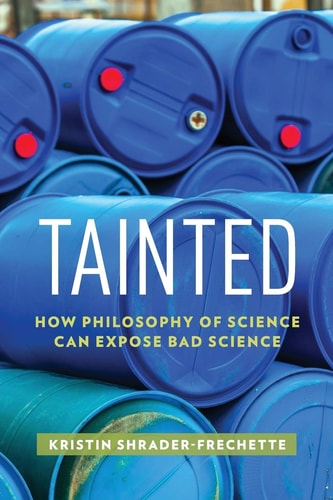
Tainted
0
0
As an Amazon Associate and affiliate partner, Menrva Books earns from qualifying purchases. Learn more
Author Description
Three-fourths of scientific research in the United States is funded by special interests. Many of these groups have specific practical goals, such as developing pharmaceuticals or establishing that a pollutant causes only minimal harm. For groups with financial conflicts of interest, their scientific findings often can be deeply flawed.To uncover and assess these scientific flaws, award-winning biologist and philosopher of science Kristin Shrader-Frechette uses the analytical tools of classic philosophy of science. She identifies and evaluates the concepts, data, inferences, methods, models, and conclusions of science tainted by the influence of special interests. As a result, she challenges accepted scientific findings regarding risks such as chemical toxins and carcinogens, ionizing radiation, pesticides, hazardous-waste disposal, development of environmentally sensitive lands, threats to endangered species, and less-protective standards for workplace-pollution exposure. In so doing, she dissects the science on which many contemporary scientific controversies turn. Demonstrating and advocating "liberation science," she shows how practical, logical, methodological, and ethical evaluations of science can both improve its quality and credibility -- and protect people from harm caused by flawed science, such as underestimates of cancers caused by bovine growth hormones, cell phones, fracking, or high-voltage wires.This book is both an in-depth look at the unreliable scientific findings at the root of contemporary debates in biochemistry, ecology, economics, hydrogeology, physics, and zoology -- and a call to action for scientists, philosophers of science, and all citizens.
Menrva's Summary
THE THESIS
This book investigates the extent to which special interest funding compromises the integrity of scientific research and policy in the United States. Kristin S. Shrader-Frechette, a philosopher of science and biologist, utilizes rigorous analytical frameworks to expose how financial conflicts of interest lead to flawed data, biased models, and unreliable conclusions. She argues that by applying ethical and logical scrutiny, the scientific community can move toward a model of 'liberation science' that prioritizes public safety over corporate agendas.
THE SCOPE MAP
What You Will Find
- Analysis of scientific methodologies in biochemistry, ecology, and hydrogeology
- Evaluation of risk assessment models regarding toxins, radiation, and hazardous waste
- Case studies on bovine growth hormones, cell phone safety, and fracking
- A framework for identifying logical and methodological flaws in industry-funded research
Scope Limits
- The text does not provide a comprehensive history of all scientific funding models
- It does not offer a technical manual for laboratory experimental design
THE AUTHORITY PERSPECTIVE
Experts recognize this work as a critical contribution to the intersection of ethics and science policy, noting its high level of academic rigor. Readers frequently highlight the density of the prose, which demands a strong grasp of both philosophical logic and scientific methodology.
Page Count:
312
Publication Date:
2016-04-01
Publisher:
Oxford University Press
ISBN-10:
019060381X
ISBN-13:
9780190603816
Sociology of Science
Philosophy of
Public Health
Science Policy
Community Tags
Similar Books