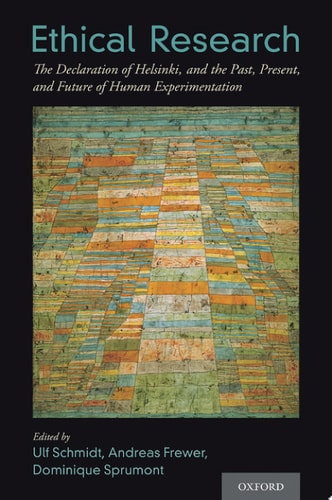
Ethical Research: The Declaration of Helsinki, and the Past, Present, and Future of Human Experimentation
0
0
As an Amazon Associate and affiliate partner, Menrva Books earns from qualifying purchases. Learn more
Author Description
At the heart of research with human beings is the moral notion that the experimental subject is altruistic, and is primarily concerned for the welfare of others. Beneath the surface, however, lies a very different ethical picture. Individuals participating in potentially life-saving research sometimes take on considerable risks to their own well-being. Efforts to safeguard human participants in clinical trials have intensified ever since the first version of the World Medical Association's Declaration of Helsinki (1964) and are now codified in many national and international laws and regulations. However, a comprehensive understanding of how this cornerstone document originated, changed, and functions today does not yet exist in the sphere of human research.Ethical Research brings together the work of leading experts from the fields of bioethics, health and medical law, the medical humanities, biomedicine, the medical sciences, philosophy, and history. Together, they focus on the centrality of the Declaration of Helsinki to the protection of human subjects involved in experimentation in an increasingly complex industry and in the government-funded global research environment. The volume's historical and contemporary perspectives on human research address a series of fundamental questions: Is our current human protection regime adequately equipped to deal with new ethical challenges resulting from advances in high-tech biomedical science? How important has the Declaration been in non-Western regions, for example in Eastern Europe, Africa, China, and South America? Why has the bureaucratization of regulation led to calls to pay greater attention to professional responsibility? Ethical Research offers insight into the way in which philosophy, politics, economics, law, science, culture, and society have shaped, and continue to shape, the ideas and practices of human research.
Menrva's Summary
THE THESIS
This volume investigates the historical evolution, global implementation, and contemporary efficacy of the Declaration of Helsinki as the primary framework for protecting human subjects in medical experimentation. The editors, Andreas Frewer, Dominique Sprumont, and Ulf Schmidt, curate a multidisciplinary collection of essays from experts in bioethics, law, and medical history. The text argues that while the Declaration serves as a cornerstone for clinical trial ethics, its application faces significant pressure from the bureaucratization of research, rapid technological advancement, and diverse cultural interpretations across global regions.
THE SCOPE MAP
What You Will Find
- Historical analysis of the origins and subsequent revisions of the Declaration of Helsinki since 1964.
- Comparative studies on the adoption and impact of research ethics in non-Western regions including China, Africa, and South America.
- Critical examination of the intersection between biomedical innovation and regulatory oversight.
Scope Limits
- The text does not provide a manual for institutional review board (IRB) procedures.
- It does not offer a definitive legal resolution to current international conflicts in patent law or pharmaceutical industry practices.
THE AUTHORITY PERSPECTIVE
Experts recognize this volume as a comprehensive academic resource for understanding the complexities of global research ethics. Readers frequently note the scholarly density of the prose, which makes it a suitable reference for professionals in medical law and bioethics.
Page Count:
604
Publication Date:
2020-01-01
Publisher:
Oxford University Press
ISBN-10:
0190093447
ISBN-13:
9780190093440
Philosophy
History
Clinical Research
Medical
Public Health
Medical Law
Medicine history
Bioethics
Philosophy of
Allied Health
Community Tags
Similar Books






Reader Comments
Share Your Thoughts
No comments yet. Be the first to share your thoughts!