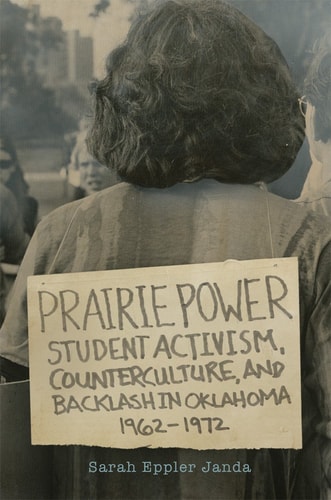
Prairie Power: Student Activism, Counterculture, and Backlash in Oklahoma, 1962-1972
0
0
As an Amazon Associate and affiliate partner, Menrva Books earns from qualifying purchases. Learn more
Author Description
Student radicals and hippies--in Oklahoma? Though most scholarship about 1960s-era student activism and the counterculture focuses on the East and West Coasts, Oklahoma's college campuses did see significant activism and "dropping out." In Prairie Power, Sarah Eppler Janda fills a gap in the historical record by connecting the activism of Oklahoma students and the experience of hippies to a state and a national history from which they have been absent. Janda shows that participants in both student activism and retreat from conformist society sought connections to Oklahoma's past while forging new paths for themselves. She shows that Oklahoma students linked their activism with the grassroots socialist radicalism and World War I-era anti-draft protest of their grandparents' generation, citing Woody Guthrie, Oscar Ameringer, and the Wobblies as role models. Many movement organizers in Oklahoma, especially those in the University of Oklahoma's chapter of Students for a Democratic Society and the anti-war movement, fit into a larger midwestern and southwestern activist mentality of "prairie power": a blend of free-speech advocacy, countercultural expression, and anarchist tendencies that set them apart from most East Coast student activists. Janda also reveals the vehemence with which state officials sought to repress campus "agitators," and discusses Oklahomans who chose to retreat from the mainstream rather than fight to change it. Like their student activist counterparts, Oklahoma hippies sought inspiration from older precedents, including the back-to-the-land movement and the search for authenticity, but also Christian evangelicalism and traditional gender roles. Drawing on underground newspapers and declassified FBI documents, as well as interviews the author conducted with former activists and government officials, Prairie Power will appeal to those interested in Oklahoma's history and the counte
Menrva's Summary
THE THESIS
This book investigates the nature and impact of student activism and countercultural movements in Oklahoma during the pivotal decade of the 1960s, challenging the common perception that such phenomena were confined to the East and West Coasts. Sarah Eppler Janda, drawing on extensive archival research and interviews, connects the experiences of Oklahoma's radicals and hippies to both state-specific historical precedents and broader national trends. The work argues that these movements, while distinct, shared a desire to connect with Oklahoma's past while forging new identities, and that they faced significant opposition from state authorities.
THE SCOPE MAP
- Analysis of student activism on Oklahoma college campuses, including the role of organizations like Students for a Democratic Society.
- Examination of the counterculture movement in Oklahoma, including the experiences of hippies and those who retreated from mainstream society.
- Exploration of the concept of "prairie power" as a distinct midwestern and southwestern activist mentality.
- Discussion of the historical influences on Oklahoma activists, such as socialist radicalism and earlier protest movements.
- Investigation into the state's efforts to repress campus "agitators" using declassified FBI documents.
- Insights into the diverse inspirations for Oklahoma hippies, ranging from the back-to-the-land movement to Christian evangelicalism.
- Use of primary sources including underground newspapers, declassified government documents, and interviews with former activists and officials.
THE AUTHORITY PERSPECTIVE
This book fills a notable gap in the historical record by focusing on student activism and counterculture in Oklahoma, a region often overlooked in broader studies of the 1960s. By connecting local movements to national trends and historical precedents, Janda offers a nuanced understanding of "prairie power" as a distinct form of activism. The use of diverse primary sources, including interviews and declassified documents, lends significant weight to its arguments, appealing to scholars of American history, social movements, and regional studies.
Page Count:
218
Publication Date:
2018-01-01
Publisher:
University of Oklahoma Press
ISBN-10:
0806157941
ISBN-13:
9780806157948
History
Non-Fiction
Social History
American History
Counterculture
Regional History
Activism
Community Tags
Similar Books