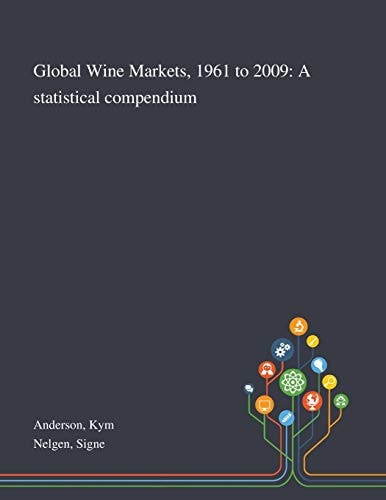
Global Wine Markets, 1961 to 2009: A Statistical Compendium
0
0
As an Amazon Associate and affiliate partner, Menrva Books earns from qualifying purchases. Learn more
Author Description
Until very recently, most grape-based wine was consumed close to where it was produced, and mostly that was in Europe. Barely one-tenth of the world's wine production was exported prior to the 1970s, even counting intra-European trade. The latest wave of globalization has changed that forever. Now more than one-third of all wine consumed globally is produced in another country, and Europe's dominance of global wine trade has been greatly diminished by the surge of exports from 'New World' producers. New consumers also have come onto the scene as incomes have grown, eating habits have changed and tastes have broadened. Asia in particular is emerging as a new and rapidly growing wine market - and in China that is stimulating the development of local, modern production capability that, in volume terms, already rivals that of Argentina, Australia and South Africa. This latest edition of global wine statistics therefore not only updates data to 2009 and revises past data, but also expands on earlier editions in a number of ways. For example, we now separately identify an extra eight Asian countries or customs areas (Hong Kong, India, Korea, Malaysia, Philippines, Singapore, Taiwan and Thailand) in addition to China and Japan. We also include more than 50 new tables to cover such items as excise and import taxes, per capita expenditure on wine, the share of domestic sales in off-trade, the shares of the largest firms in national markets and globally, and the most powerful wine brands globally. Given the growing interest in the health aspects of alcohol consumption, we now express it per adult as well as per capita. Perhaps the most significant addition to this latest version is a new section that provides estimates of the volume, value and hence unit value of wine production, consumption, exports and imports for four catagories: sparkling wines, and non-premium, commercial-premium and super-premium still wines. This work was published by Saint Philip Street Press pursu
Menrva's Summary
THE THESIS
This compendium investigates the transformation of global wine markets from a predominantly localized consumption model to a globally interconnected trade network. The authors, Kym Anderson and Signe Nelgen, draw upon extensive statistical data from 1961 to 2009 to chart this evolution. The work details how globalization, rising incomes, and changing consumer habits have shifted dominance from traditional European producers to 'New World' exporters, while also highlighting the emergence of new markets, particularly in Asia, and the development of local production capabilities in regions like China.
THE SCOPE MAP
- Statistical data on global wine production, consumption, exports, and imports from 1961 to 2009.
- Analysis of the shift from localized consumption to globalized trade, with a focus on Europe's diminishing dominance and the rise of New World producers.
- Inclusion of data for eight additional Asian countries/customs areas beyond China and Japan.
- More than 50 new tables covering excise and import taxes, per capita expenditure, off-trade sales share, market shares of major firms, and top wine brands.
- Expression of alcohol consumption per adult, in addition to per capita.
- A new section estimating volume, value, and unit value for sparkling wines, and non-premium, commercial-premium, and super-premium still wines.
THE AUTHORITY PERSPECTIVE
This statistical compendium provides a comprehensive overview of global wine market trends over nearly five decades. The inclusion of detailed data on trade, taxes, consumer expenditure, and market shares offers a robust resource for understanding the economic forces that have reshaped the wine industry. The expansion to include more Asian markets and detailed breakdowns by wine category reflects the evolving landscape of global wine consumption and production. The work is structured to serve as a definitive reference for economists, industry professionals, and researchers interested in the globalization of wine.
Page Count:
504
Publication Date:
2020-10-09
Publisher:
Creative Media Partners, LLC
ISBN-10:
1013284143
ISBN-13:
9781013284144
Economics
Business
History
Non-Fiction
Trade
Community Tags
Other Editions(2)

Similar Books










Reader Comments
Share Your Thoughts
No comments yet. Be the first to share your thoughts!