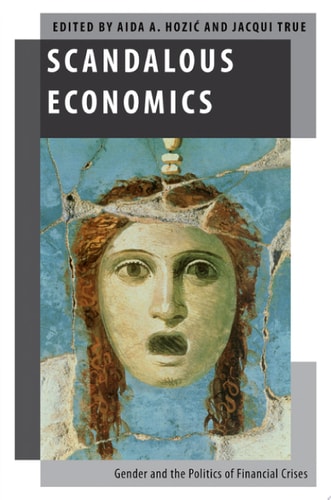
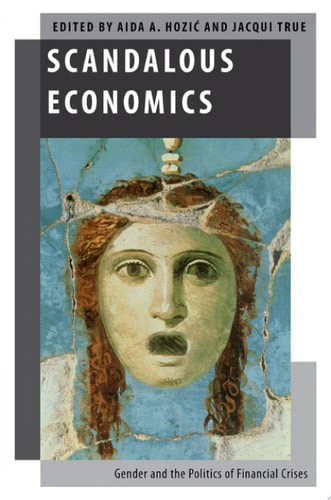
Scandalous Economics: Gender and the Politics of Financial Crises
0
0
As an Amazon Associate and affiliate partner, Menrva Books earns from qualifying purchases. Learn more
Author Description
Of all of the lies, fragile alliances, and predatory financial dealings that have been revealed in the wake of the Global Financial Crisis of 2008, we have yet to come to terms with the ways in which structural inequalities around gender and race factor into (and indeed make possible) the current economic order. Scandalous Economics is about "silences" - the astonishing neglect of gender and race in explanations of the Global Financial Crisis. But, it is also about "noises" - the sexual scandals and gendered austerity policies that have relegated public debate, and the crisis itself, into political oblivion.While feminist economists and movements such as Occupy Wall Street have pointed to the distributional inequalities that are an effect of financial deregulation, scholars haven't really grappled with the representational inequalities inherent in the way we view the politics of the market. For example, capitalism won't be made more equitable simply by appointing women to leadership positions within financial firms or corporations. And the next crisis will not be averted if our understandings of gendered inequalities are framed by sexual scandals in media and popular culture. We need to look at the activities and the privileges of the advantaged - the "TED women" of the crisis -- as much as the victimization of the disadvantaged - to fully grasp the interplay between gender and economy in this fragile age of restoration. Scandalous Economics breaks new ground by doing precisely this. It argues that normalization of the post-GFC economic order in the face of its obvious breakdown(s) has been facilitated by co-optation of feminist and queer perspectives into national and international responses to the crisis.Scandalous Economics builds upon the Occupy movement and other critical analysis of the GFC to comprehensively examine gendered material, ideational and representational dimensions that have served to make the crisis and its effects, 'the new normal' in Europe and
Menrva's Summary
THE THESIS
This book investigates how structural inequalities regarding gender and race are systematically ignored in mainstream explanations of the 2008 Global Financial Crisis. Authors Aida A. Hozic and Jacqui True utilize a feminist political economy framework to argue that the post-crisis economic order is maintained through the co-optation of feminist and queer perspectives. By analyzing the interplay between representational inequalities and market politics, the authors contend that current economic recovery efforts often obscure deeper systemic failures.
THE SCOPE MAP
What You Will Find
- Analysis of gendered austerity policies in Europe and beyond.
- Critique of the 'TED women' phenomenon and corporate diversity initiatives.
- Examination of how sexual scandals are used to distract from financial deregulation.
- Theoretical synthesis of feminist economics and critical international relations.
Scope Limits
- The text focuses primarily on the Western-centric post-GFC economic order.
- It does not provide a comprehensive technical manual for financial market reform.
THE AUTHORITY PERSPECTIVE
Scholars in the field of international political economy recognize this work as a critical intervention in the study of financial crises. Readers frequently note the academic density of the prose, which requires a foundational understanding of feminist theory and political economy to fully engage with the arguments.
Page Count:
352
Publication Date:
2016-01-01
Publisher:
Oxford University Press
ISBN-10:
0190614099
ISBN-13:
9780190614096
Economics
Gender Studies
International relations
Feminist Theory
Public Policy
Womens Studies
Sociology
Economics history
Community Tags
Similar Books




Reader Comments
Share Your Thoughts
No comments yet. Be the first to share your thoughts!