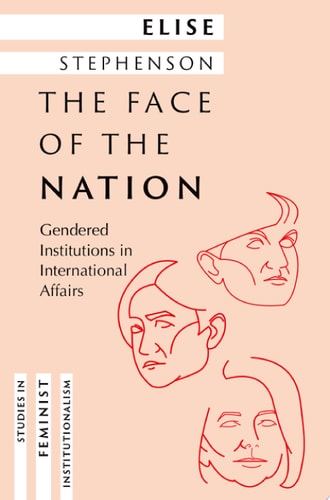
The Face of the Nation: Gendered Institutions in International Affairs
0
0
As an Amazon Associate and affiliate partner, Menrva Books earns from qualifying purchases. Learn more
Author Description
Foreign services globally are undergoing fundamental and rapid gendered change, spurred on by shifting social and governance norms and even the adoption of an explicit feminist foreign policy in some stages. For some, this has resulted in women's rapidly increasing representation at the frontlines of global governance. Yet, compounded by COVID-19, a rise in right-wing misogyny and extremism, and sometimes archaically slow-moving institutions, progress is marred by women's continued, entrenched under-representation in leadership and devastating challenges that have increased in recent years. Women remain frequently side-lined, marginalized, under-valued, and overlooked in international affairs. In short, international affairs has a gender problem, and remains one of the worst-performing sectors of the state. After studying women's leadership and gender relations across four international affairs agencies spanning diplomacy, defense, national security, policing, and intelligence, The Face of the Nation contributes empirical data from the last 30+ years on women's representation in a leading case context--Australia--to understand the disconnect between pockets of progress and undercurrents of resistance. Australia is a global leader in terms of representation of women and policy supports for gender equality in governance. Yet, Australia also demonstrates how deeply gendered, racialized, and heteronormative international institutions remain. Through in-depth interviews with almost 80 global leaders, including with Australia's first female prime minister, Julia Gillard, and first female foreign minister, Julie Bishop, this book delivers a much-needed Intersectional Feminist Institutionalist approach to trace the evolution of inequalities in international affairs and interrogate why women still remain under-represented in international affairs.
Menrva's Summary
THE THESIS
This book investigates why international affairs institutions continue to exhibit persistent gender inequality despite global shifts toward more inclusive governance norms. Author Elise Stephenson, a Deputy Director with extensive research credentials, utilizes an Intersectional Feminist Institutionalist framework to analyze the structural barriers preventing women from reaching leadership roles. By examining the disconnect between policy progress and institutional resistance, the work argues that international agencies remain deeply gendered, racialized, and heteronormative environments.
THE SCOPE MAP
What You Will Find
- Empirical data spanning over 30 years regarding women's representation in international affairs agencies.
- A comparative analysis of diplomacy, defense, national security, policing, and intelligence sectors.
- Qualitative evidence derived from in-depth interviews with nearly 80 global leaders, including former Australian prime ministers and foreign ministers.
- An application of Intersectional Feminist Institutionalism to explain the persistence of institutional bias.
THE AUTHORITY PERSPECTIVE
Experts recognize this work as a significant contribution to the study of gendered institutional change within the public sector. Readers frequently note the depth of the primary source interviews, which provide a rare, high-level perspective on the systemic challenges facing women in global governance.
Page Count:
304
Publication Date:
2024-01-01
Publisher:
Oxford University Press, USA
ISBN-10:
0197632726
ISBN-13:
9780197632727
Politics
World politics
Gender Studies
International relations
Sociology
Feminist Theory
Public Policy
Community Tags
Similar Books