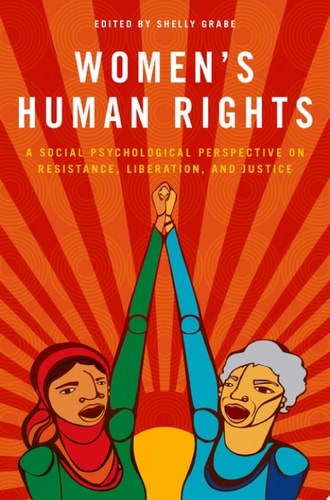
Women's Human Rights: A Social Psychological Perspective on Resistance, Liberation, and Justice
0
0
As an Amazon Associate and affiliate partner, Menrva Books earns from qualifying purchases. Learn more
Author Description
At a United Nations conference in 1995, 189 governments adopted the Beijing Platform for Action, an international agenda for women's equality and a statement of women's rights as human rights. Since that time, violations of women's human rights have become a widely-documented problem across many academic disciplines, international organizations, and activist social movements. Nevertheless, violations against women occur unabated despite widespread commitments internationally to draw increased attention to women's experiences. Given that a focus on women's rights was first put forth two decades ago, the question remains: why do egregious violations of women's rights continue?Edited by Shelly Grabe, Women's Human Rights: A Social Psychological Perspective on Resistance, Liberation, and Justice contributes to the discussion of why women's human rights warrants increased focus in the context of globalization and how psychology can provide the currently missing, but necessary, links between transnational feminism and the discourse on women's human rights and neoliberalism. This volume takes a radically different approach to women's human rights by turning its attention to a variety of disciplines and, as a result, develops new ideas regarding how psychology can be relevant in the study or actualization of women's human rights. By doing so, it makes it very clear for readers as to how activist scholarship can make a unique contribution to the defense of women's rights.Rather than using examples that have been sensationalized throughout academia and advocacy (i.e. genital mutilation), each of this book's contributing authors has used examples (rape, sexual orientation, homelessness, civic participation, violence) of specific human rights violations that occur the world over in their attempt to make the relevance of psychology to this topic more visible to the reader.
Menrva's Summary
THE THESIS
This volume investigates why egregious violations of women's human rights persist globally despite international policy commitments and how the field of psychology can bridge the gap between transnational feminism and neoliberal discourse. Shelly Grabe, a professor of psychology, curates a collection of scholarly contributions that examine the intersection of social psychological theory and human rights advocacy. The text argues that psychology provides necessary, yet currently missing, analytical links to understand the mechanisms of resistance, liberation, and justice in the context of globalization.
THE SCOPE MAP
What You Will Find
- Analysis of human rights violations including rape, sexual orientation discrimination, homelessness, and barriers to civic participation.
- Theoretical frameworks connecting neoliberalism to the suppression of women's rights.
- Methodologies for integrating activist scholarship into psychological research.
Scope Limits
- The text avoids sensationalized or singular focus on specific cultural practices like genital mutilation in favor of broader systemic issues.
- It does not provide a comprehensive legal history of the Beijing Platform for Action, focusing instead on psychological perspectives.
THE AUTHORITY PERSPECTIVE
Experts highlight this text as a significant contribution to the interdisciplinary study of human rights, noting its success in moving psychological discourse beyond traditional academic boundaries. Readers frequently observe that the book serves as a bridge for scholars and activists seeking to apply psychological theory to real-world social justice efforts.
Page Count:
272
Publication Date:
2017-11-01
Publisher:
Oxford University Press
ISBN-10:
0190614617
ISBN-13:
9780190614614
Sociology
Political Activity
Woman Studies
Human rights
Womens rights
Globalization
Feminism
Community Tags
Other Editions(2)
Similar Books














Reader Comments
Share Your Thoughts
No comments yet. Be the first to share your thoughts!