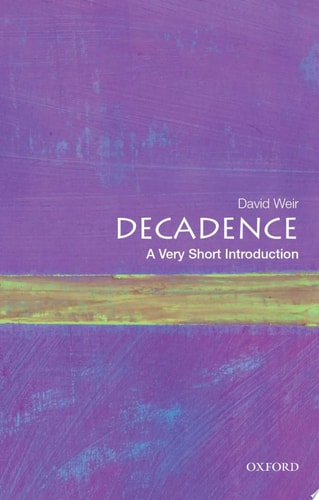
Decadence: A Very Short Introduction (Very Short Introductions)
0
0
As an Amazon Associate and affiliate partner, Menrva Books earns from qualifying purchases. Learn more
Author Description
The history of decadent culture runs from ancient Rome to nineteenth-century Paris, Victorian London, fin de siècle Vienna, Weimar Berlin, and beyond. The decline of Rome provides the pattern for both aesthetic and social decadence, a pattern that artists and writers in the nineteenth century imitated, emulated, parodied, and otherwise manipulated for aesthetic gain. What begins as the moral condemnation of modernity in mid-nineteenth century France on the part of decadent authors such as Charles Baudelaire ends up as the perverse celebration of the pessimism that accompanies imperial decline. This delight in decline informs the rich canon of decadence that runs from Joris-Karl Huysmans's À Rebours to Oscar Wilde's The Picture of Dorian Gray, Aubrey Beardsley's drawings, Gustav Klimt's paintings, and numerous other works. In this Very Short Introduction, David Weir explores the conflicting attitudes towards modernity present in decadent culture by examining the difference between aesthetic decadence--the excess of artifice--and social decadence, which involves excess in a variety of forms, whether perversely pleasurable or gratuitously cruel. Such contrariness between aesthetic and social decadence led some of its practitioners to substitute art for life and to stress the importance of taste over morality, a maneuver with far-reaching consequences, especially as decadence enters the realm of popular culture today.ABOUT THE SERIES: The Very Short Introductions series from Oxford University Press contains hundreds of titles in almost every subject area. These pocket-sized books are the perfect way to get ahead in a new subject quickly. Our expert authors combine facts, analysis, perspective, new ideas, and enthusiasm to make interesting and challenging topics highly readable.
Menrva's Summary
THE THESIS
What defines the concept of decadence, and how has it evolved from a moral condemnation of modernity into a complex aesthetic and social framework? David A. Weir, a scholar of modern literature and culture, utilizes historical analysis and literary theory to trace the trajectory of decadence from ancient Rome to contemporary popular culture. He argues that the term functions as a dual construct, oscillating between aesthetic artifice and social excess, ultimately shaping how modern societies perceive decline and morality.
THE SCOPE MAP
What You Will Find
- Historical analysis of decadent movements in 19th-century France, Victorian London, and Weimar Berlin.
- Comparative study of aesthetic decadence versus social decadence.
- Examination of key figures including Charles Baudelaire, Joris-Karl Huysmans, and Oscar Wilde.
- Analysis of the shift from moral judgment to the celebration of pessimism.
Scope Limits
- The text does not provide an exhaustive biography of every decadent artist.
- It does not offer a comprehensive sociological study of all forms of societal decline.
THE AUTHORITY PERSPECTIVE
Readers frequently note the concise yet dense nature of the prose, which effectively synthesizes complex cultural history into a brief format. Experts highlight this as a useful introductory text for students and general readers seeking to understand the intellectual foundations of the decadent movement.
Page Count:
154
Publication Date:
2018-01-01
Publisher:
Oxford University Press
ISBN-10:
0190610247
ISBN-13:
9780190610241
Non-Fiction
Philosophy
History
Art History
Degeneration
English & College Success
English
Civilization
Literary Criticism
Community Tags
Similar Books