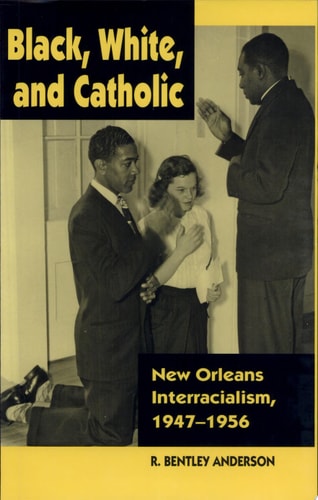
Black, White, and Catholic New Orleans: Interracialism, 1947-1956
0
0
As an Amazon Associate and affiliate partner, Menrva Books earns from qualifying purchases. Learn more
Author Description
Most histories of the Civil Rights Movement start with all the players in place--among them organized groups of African Americans, White Citizens' Councils, nervous politicians, and religious leaders struggling to find the right course. Anderson, however, takes up the historical moment right before that, when small groups of black and white Catholics in the city of New Orleans began efforts to desegregate the archdiocese, and the Society of Jesus (Jesuits) began, in fits and starts, to integrate quietly the New Orleans Province. Anderson leads readers through the tumultuous years just after World War II when the Roman Catholic Church in the American South struggled to reconcile its commitment to social justice with the legal and social heritage of Jim Crow society. Though these early efforts at reform, by and large, failed, they did serve to galvanize Catholic supporters and opponents of the Civil Rights Movement and provided a model for more successful efforts at desegregation in the '60s. As a Jesuit himself, Anderson has access to archives that remain off-limits to other scholars. His deep knowledge of the history of the Catholic Church also allows him to draw connections between this historical period and the present. In the resistance to desegregation, Anderson finds expression of a distinctly American form of Catholicism, in which lay people expect Church authorities to ratify their ideas and beliefs in an almost democratic fashion. The conflict he describes is as much between popular and hierarchical models of the Church as between segregation and integration. This book has been made possible through a grant from the Louisiana Endowment for the Humanities, a state affiliate of the National Endowment for the Humanities.
Menrva's Summary
THE THESIS
This book investigates the complex and often contradictory role of the Roman Catholic Church in New Orleans during the nascent years of the Civil Rights Movement. R. Bentley Anderson, a Jesuit himself, delves into the period between 1947 and 1956, examining the efforts of small groups of black and white Catholics and the Society of Jesus to desegregate the archdiocese and its province. The narrative navigates the tension between the Church's stated commitment to social justice and the deeply entrenched Jim Crow laws and social structures of the American South. While these early reforms largely failed, they laid crucial groundwork for future desegregation efforts and highlighted a conflict between popular and hierarchical models of Catholicism.
THE SCOPE MAP
- An examination of the period 1947-1956 in New Orleans, focusing on Catholic efforts toward desegregation.
- Analysis of the Society of Jesus's attempts to integrate its New Orleans Province.
- Exploration of the conflict between the Church's social justice ideals and the realities of Jim Crow society.
- Discussion of the role of both lay Catholics and Church authorities in the desegregation debate.
- Insights drawn from archival access unique to the author's position as a Jesuit.
- Connections made between the historical period and contemporary expressions of American Catholicism.
THE AUTHORITY PERSPECTIVE
This historical account is grounded in deep archival research, particularly within Jesuit archives, offering a unique perspective on the early Civil Rights Movement in New Orleans. The book is noted for its nuanced exploration of the internal conflicts within the Catholic Church regarding desegregation, highlighting the tension between hierarchical authority and popular sentiment. Its analysis extends beyond the immediate historical context, drawing parallels to contemporary expressions of American Catholicism and the evolving relationship between faith and social action.
Page Count:
292
Publication Date:
2005-01-01
Publisher:
Vanderbilt University Press
ISBN-10:
0826514839
ISBN-13:
9780826514837
History
Religion
Non-Fiction
Social History
American South
Community Tags
Similar Books