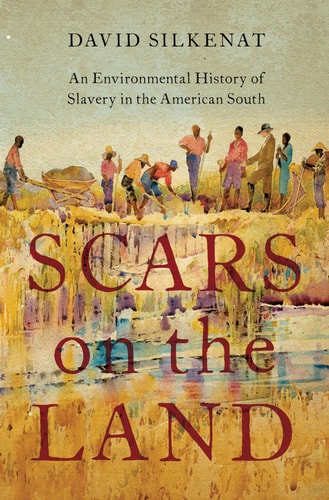
Scars on the Land: An Environmental History of Slavery in the American South
0
0
As an Amazon Associate and affiliate partner, Menrva Books earns from qualifying purchases. Learn more
Author Description
They worked Virginia's tobacco fields, South Carolina's rice marshes, and the Black Belt's cotton plantations. Wherever they lived, enslaved people found their lives indelibly shaped by the Southern environment. By day, they plucked worms and insects from the crops, trod barefoot in the mud as they hoed rice fields, and endured the sun and humidity as they planted and harvested the fields. By night, they clandestinely took to the woods and swamps to trap opossums and turtles, to visit relatives living on adjacent plantations, and at times to escape slave patrols and escape to freedom. Scars on the Land is the first comprehensive history of American slavery to examine how the environment fundamentally formed enslaved people's lives and how slavery remade the Southern landscape. Over two centuries, from the establishment of slavery in the Chesapeake to the Civil War, one simple calculation had profound consequences: rather than measuring productivity based on outputs per acre, Southern planters sought to maximize how much labor they could extract from their enslaved workforce. They saw the landscape as disposable, relocating to more fertile prospects once they had leached the soils and cut down the forests. On the leading edge of the frontier, slavery laid waste to fragile ecosystems, draining swamps, clearing forests to plant crops and fuel steamships, and introducing devastating invasive species. On its trailing edge, slavery left eroded hillsides, rivers clogged with sterile soil, and the extinction of native species. While environmental destruction fueled slavery's expansion, no environment could long survive intensive slave labor. The scars manifested themselves in different ways, but the land too fell victim to the slave owner's lash.Although typically treated separately, slavery and the environment naturally intersect in complex and powerful ways, leaving lasting effects from the period of emancipation through modern-day reckonings with racial justice.
Menrva's Summary
THE THESIS
This work investigates the symbiotic relationship between the institution of slavery and the ecological transformation of the American South. David Silkenat, a historian specializing in the American South, utilizes a wide array of primary sources to argue that the environmental degradation of the region was not merely a byproduct of plantation agriculture but a fundamental component of the slave economy. He demonstrates how the relentless pursuit of labor extraction led to the systematic depletion of soil, the destruction of forests, and the permanent alteration of Southern ecosystems.
THE SCOPE MAP
What You Will Find
- An analysis of the environmental impact of tobacco, rice, and cotton cultivation across two centuries.
- A detailed examination of how enslaved people navigated and utilized the natural landscape for survival and resistance.
- Evidence drawn from plantation records, agricultural journals, and contemporary accounts of the Southern frontier.
- A synthesis of how the exhaustion of natural resources drove the westward expansion of the slave system.
THE AUTHORITY PERSPECTIVE
Experts identify this text as a significant contribution to the field of environmental history, noting its ability to bridge the gap between ecological studies and the history of human bondage. Readers frequently highlight the clarity of the author's prose and the depth of the research provided in connecting land management practices to the social realities of the antebellum South.
Page Count:
269
Publication Date:
2021-01-01
Publisher:
Oxford University Press
ISBN-10:
0197564240
ISBN-13:
9780197564240
History
Nature
American History
Environmental History
American South
Social History
Slavery
United States
Community Tags
Similar Books