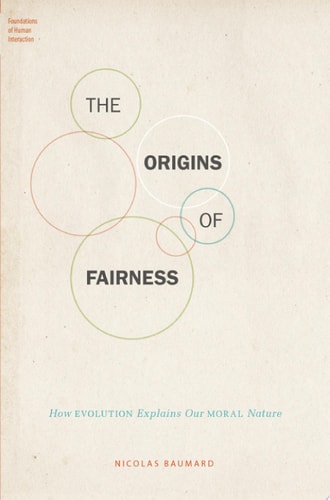
The Origins of Fairness: How Evolution Explains Our Moral Nature
0
0
As an Amazon Associate and affiliate partner, Menrva Books earns from qualifying purchases. Learn more
Author Description
In order to describe the logic of morality, “contractualist” philosophers have studied how individuals behave when they choose to follow their moral intuitions. These individuals, contractualists note, often act as if they have bargained and thus reached an agreement with others about how to distribute the benefits and burdens of mutual cooperation. Using this observation, such philosophers argue that the purpose of morality is to maximize the benefits of human interaction. The resulting “contract” analogy is both insightful and puzzling. On one hand, it captures the pattern of moral intuitions, thus answering questions about human cooperation: why do humans cooperate? Why should the distribution of benefits be proportionate to each person's contribution? Why should the punishment be proportionate to the crime? Why should the rights be proportionate to the duties? On the other hand, the analogy provides a mere as-if explanation for human cooperation, saying that cooperation is “as if” people have passed a contract-but since they didn't, why should it be so? To evolutionary thinkers, the puzzle of the missing contract is immediately reminiscent of the puzzle of the missing “designer” of life-forms, a puzzle that Darwin's theory of natural selection essentially resolved. Evolutionary and contractualist theory originally intersected at the work of philosophers John Rawls and David Gauthier, who argued that moral judgments are based on a sense of fairness that has been naturally selected. In this book, Nicolas Baumard further explores the theory that morality was originally an adaptation to the biological market of cooperation, an arena in which individuals competed to be selected for cooperative interactions. In this environment, Baumard suggests, the best strategy was to treat others with impartiality and to share the costs and benefits of cooperation in a fair way, so that those who offered less than others were left out of cooperation while those who offered more were selected as partners.
Menrva's Summary
THE THESIS
This book investigates the evolutionary origins of human morality by proposing that our sense of fairness is a biological adaptation developed to facilitate successful cooperation in a competitive social market. Nicolas Baumard, a researcher in cognitive science and evolutionary psychology, synthesizes contractualist philosophy with evolutionary biology. He argues that moral intuitions are not merely social constructs but are evolved strategies that allow individuals to signal their value as cooperative partners, thereby securing mutual benefits in social interactions.
THE SCOPE MAP
What You Will Find
- An analysis of the biological market theory of cooperation.
- A synthesis of contractualist philosophy and evolutionary selection pressures.
- Explanations for specific moral behaviors, including fairness in distribution and proportionality in punishment.
Scope Limits
- The text does not provide a comprehensive history of moral philosophy or ethics.
- It does not address the cultural variations of morality in non-Western societies in significant detail.
THE AUTHORITY PERSPECTIVE
Experts in evolutionary psychology and behavioral science frequently cite this work as a significant contribution to the naturalistic explanation of human ethics. Readers often note the academic density of the prose, which requires a foundational understanding of evolutionary theory to fully grasp the author's arguments.
Page Count:
268
Publication Date:
2016-01-01
Publisher:
Oxford University Press
ISBN-10:
0190613912
ISBN-13:
9780190613914
Philosophy
Anthropology
Evolutionary Psychology
Ethics
Ethics history
Social Science
Community Tags
Similar Books