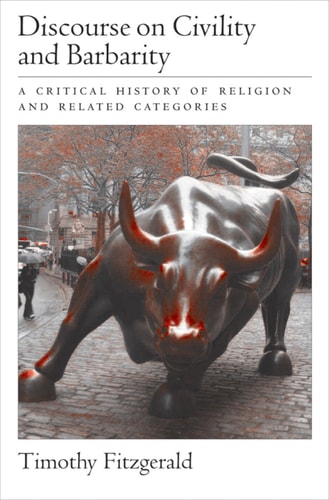
Discourse on Civility and Barbarity
0
0
As an Amazon Associate and affiliate partner, Menrva Books earns from qualifying purchases. Learn more
Author Description
In recent years scholars have begun to question the usefulness of the category of ''religion'' to describe a distinctive form of human experience and behavior. In his last book, The Ideology of Religious Studies (OUP 2000), Timothy Fitzgerald argued that ''religion'' was not a private area of human existence that could be separated from the public realm and that the study of religion as such was thus impossibility. In this new book he examines a wide range of English-language texts to show how religion became transformed from a very specific category indigenous to Christian culture into a universalist claim about human nature and society. These claims, he shows, are implied by and frequently explicit in theories and methods of comparative religion. But they are also tacitly reproduced throughout the humanities in the relatively indiscriminate use of ''religion'' as an a priori valid cross-cultural analytical concept, for example in historiography, sociology, and social anthropology. Fitzgerald seeks to link the argument about religion to the parallel formation of the ''non-religious'' and such dichotomies as church-state, sacred-profane, ecclesiastical-civil, spiritual-temporal, supernatural-natural, and irrational-rational. Part of his argument is that the category ''religion'' has a different logic compared to the category ''sacred,'' but the two have been consistently confused by major writers, including Durkheim and Eliade. Fitzgerald contends that ''religion'' imagined as a private belief in the supernatural was a necessary conceptual space for the simultaneous imagining of ''secular'' practices and institutions such as politics, economics, and the Nation State. The invention of ''religion'' as a universal type of experience, practice, and institution was partly the result of sacralizing new concepts of exchange, ownership, and labor practices, applying ''scientific'' rationality to human behavior, administering the colonies and classifying native institutions.
Menrva's Summary
THE THESIS
This book investigates whether the category of 'religion' functions as a valid cross-cultural analytical concept or if it is a historically contingent construct rooted in Christian culture. Timothy Fitzgerald, a scholar of religious studies, utilizes a critical analysis of English-language texts to argue that the universal application of 'religion' obscures the ideological formation of secular institutions. He posits that the invention of 'religion' as a distinct sphere was necessary for the development of modern concepts like the Nation State, economics, and scientific rationality.
THE SCOPE MAP
What You Will Find
- Analysis of the historical transformation of 'religion' from a Christian-specific category to a universalist claim.
- Examination of dichotomies such as church-state, sacred-profane, and spiritual-temporal.
- Critique of major theorists including Durkheim and Eliade regarding their confusion of 'religion' and 'sacred'.
- Investigation into how the category was used to administer colonies and classify native institutions.
Scope Limits
- The text focuses primarily on English-language academic and historical texts.
- It does not provide a comprehensive history of all world religions, but rather a meta-critique of the academic discipline of religious studies.
THE AUTHORITY PERSPECTIVE
Scholars in the field of religious studies frequently cite this work as a rigorous challenge to the foundational assumptions of the discipline. Readers often note the high level of academic density and the challenging nature of Fitzgerald's deconstruction of long-standing analytical categories.
Page Count:
366
Publication Date:
2007-01-01
Publisher:
Oxford University Press
ISBN-10:
0190293640
ISBN-13:
9780190293642
Philosophy
Religion
Methodology
Critical Theory
Sociology
Cultural History
Anthropology
Cultural Anthropology
Community Tags
Other Editions(4)

Similar Books



Reader Comments
Share Your Thoughts
No comments yet. Be the first to share your thoughts!