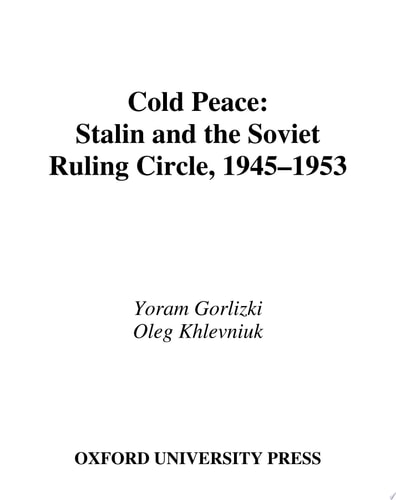
Cold Peace: Stalin and the Soviet Ruling Circle, 1945-1953
0
0
As an Amazon Associate and affiliate partner, Menrva Books earns from qualifying purchases. Learn more
Author Description
Following his country's victory over Nazi Germany, Joseph Stalin was widely hailed as a great wartime leader and international statesman. Unchallenged on the domestic front, he headed one of the most powerful nations in the world. Yet, in the period from the end of World War II until his death, Stalin remained a man possessed by his fears. In order to reinforce his despotic rule in the face of old age and uncertain health, he habitually humiliated and terrorized members of his inner circle. He had their telephones bugged and even forced his deputy, Viacheslav Molotov, to betray his own spouse as a token of his allegiance. Often dismissed as paranoid and irrational, Stalin's behavior followed a clear political logic, contend Yoram Gorlizki and Oleg Khlevniuk. Stalin's consistent and overriding goal after the war was to consolidate the Soviet Union's status as a superpower and, in the face of growing decrepitude, to maintain his own hold as leader of that power. To that end, he fashioned a system of leadership that was at once patrimonial-repressive and quite modern. While maintaining informal relations based on personal loyalty at the apex of the system, in the postwar period Stalin also vested authority in committees, elevated younger specialists, and initiated key institutional innovations with lasting consequences. Close scrutiny of Stalin's relationships with his most intimate colleagues also shows how, in the teeth of periodic persecution, Stalin's deputies cultivated informal norms and mutual understandings which provided the foundations for collective rule after his death. Based on newly released archival documents, including personal correspondence, drafts of Central Committee paperwork, new memoirs, and interviews with former functionaries and the families of Politburo members, this book will appeal to all those interested in Soviet history, political history, and the lives of dictators. Cold Peace was a CHOICE Outstanding Academic Title for 2005.
Menrva's Summary
THE THESIS
This book investigates the complex political dynamics and power struggles within Joseph Stalin's inner circle during the final years of his rule and the immediate aftermath. Yoram Gorlizki and Oleg Khlevniuk analyze Stalin's post-war consolidation of power, exploring how his seemingly paranoid actions were driven by a strategic logic to maintain the Soviet Union's superpower status and his own leadership. The authors detail the unique leadership system Stalin constructed, which blended personal loyalty with institutional innovations and the elevation of younger specialists. Furthermore, the book examines how Stalin's deputies, despite facing periodic purges, developed informal norms and understandings that paved the way for collective rule after his death.
THE SCOPE MAP
- Analysis of Joseph Stalin's leadership and political strategies from 1945 to 1953.
- Exploration of the internal dynamics and relationships within the Soviet ruling circle.
- Examination of the institutional innovations and committee structures established by Stalin.
- Discussion of the methods Stalin used to consolidate power and maintain control.
- Investigation into how Stalin's deputies navigated purges and cultivated collective rule.
- Utilizes newly released archival documents, personal correspondence, and memoirs.
- Focuses on the political logic behind Stalin's actions in his final years.
THE AUTHORITY PERSPECTIVE
Cold Peace was recognized as a CHOICE Outstanding Academic Title for 2005, indicating significant scholarly acclaim. The book's rigorous analysis of Stalin's final years and the Soviet ruling circle, based on newly accessible archival materials, has been lauded by experts. Its detailed examination of the political logic behind Stalin's actions and the foundations of post-Stalinist collective rule provides crucial insights into a pivotal period of Soviet history. The work is considered essential reading for scholars and students of Soviet history, political history, and the study of dictatorships.
Page Count:
272
Publication Date:
2004-01-15
Publisher:
Oxford University Press
ISBN-10:
0195347358
ISBN-13:
9780195347357
History
Non-Fiction
Biography
Political History
Soviet History
Community Tags
Similar Books




Reader Comments
Share Your Thoughts
No comments yet. Be the first to share your thoughts!