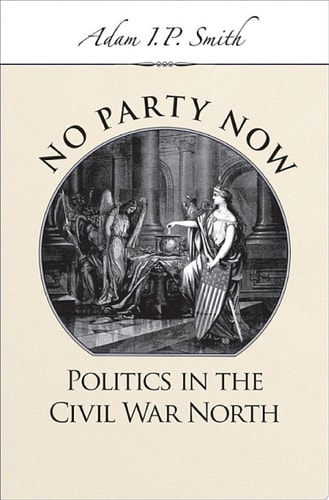
No Party Now: Politics in the Civil War North
0
0
As an Amazon Associate and affiliate partner, Menrva Books earns from qualifying purchases. Learn more
Author Description
During the Civil War, Northerners fought each other in elections with almost as much zeal as they fought Southern rebels on the battlefield. Yet politicians and voters alike claimed that partisanship was dangerous in a time of national crisis.In No Party Now, Adam I. P. Smith challenges the prevailing view that political processes in the North somehow helped the Union be more stable and effective in the war. Instead, Smith argues, early efforts to suspend party politics collapsed in the face of divisions over slavery and the purpose of the war. At the same time, new contexts for political mobilization, such as the army and the avowedly non-partisan Union Leagues, undermined conventional partisan practices. The administration's supporters soon used the power of anti-party discourse to their advantage by connecting their own antislavery arguments to a powerful nationalist ideology. By the time of the 1864 election they sought to de-legitimize partisan opposition with slogans like "No Party Now But All For Our Country!"No Party Now offers a reinterpretation of Northern wartime politics that challenges the "party period paradigm" in American political history and reveals the many ways in which the unique circumstances of war altered the political calculations and behavior of politicians and voters alike. As Smith shows, beneath the superficial unity lay profound differences about the implications of the war for the kind of nation that the United States was to become.
Menrva's Summary
THE THESIS
This book investigates how the American Civil War fundamentally altered Northern political practices and challenged the prevailing belief that partisanship was inherently dangerous during a national crisis. Adam I. P. Smith, a historian specializing in 19th-century American politics, utilizes primary source materials, election records, and contemporary political discourse to argue that the war did not stabilize Northern politics. Instead, he demonstrates that the conflict over slavery and national identity forced a transformation in how political mobilization occurred, ultimately leading to the weaponization of anti-party rhetoric by the administration.
THE SCOPE MAP
What You Will Find
- Analysis of the 1864 presidential election and its political implications
- Examination of the Union Leagues and their role in non-partisan mobilization
- Investigation into the shift from traditional party politics to nationalist ideology
- Evaluation of the 'party period paradigm' in American historiography
Scope Limits
- The book focuses primarily on the Northern political landscape rather than military strategy or Southern political developments
- It does not provide a comprehensive biography of individual political figures, focusing instead on broader systemic shifts
THE AUTHORITY PERSPECTIVE
Historians and scholars of the Civil War era recognize this work as a significant challenge to established narratives regarding wartime political stability. Readers frequently note the academic rigor of the research and the author's ability to synthesize complex political shifts into a coherent argument.
Page Count:
278
Publication Date:
2006-01-01
Publisher:
Oxford University Press
ISBN-10:
0190293349
ISBN-13:
9780190293345
History
Civil War
19th Century
American History
United States
Political History
Community Tags
Similar Books