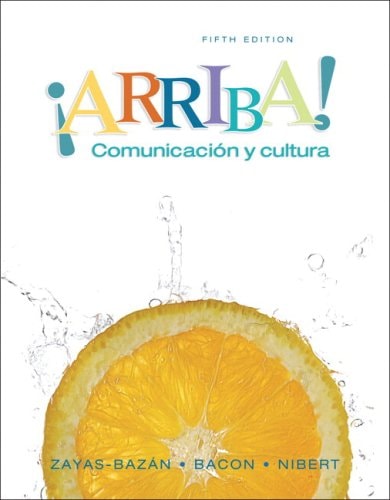
Arriba!: Comunicacion y cultura
0
0
As an Amazon Associate and affiliate partner, Menrva Books earns from qualifying purchases. Learn more
Author Description
About the Author"Terry and Gerry Audesirk" grew up in New Jersey, where they met as undergraduates. After marrying in 1970, they moved to California, where Terry earned her doctorate in marine ecology at the University of Southern California and Gerry earned his doctorate in neurobiology at the California Institute of Technology. As postdoctoral students at the University of Washington's marine laboratories, they worked together on the neural bases of behavior, using a marine mollusk as a model system. Terry and Gerry are now professors of biology at the University of Colorado at Denver, where they have taught introductory biology and neurobiology since 1982. In their research lab, funded by the National Institutes of Health, they investigate the mechanisms by which neurons are harmed by low levels of environmental pollutants. Terry and Gerry share a deep appreciation of nature and of the outdoors. They enjoy hiking in the Rockies, running near their home in the foothills west of Denver, and attempting to garden at 7000 feet in the presence of hungry deer and elk. They are long-time members of many conservation organizations. Their daughter, Heather, has added another focus to their lives. "Bruce E. Byers," a midwesterner transplanted to the hills of western Massachusetts, is a professor in the biology department at the University of Massachusetts, Amherst. He's been a member of the faculty at UMass (where he also completed his doctoral degree) since 1993. Bruce teaches introductory biology courses for both nonmajors and majors; he also teaches courses in ornithology and animal behavior. A lifelong fascination with birds ultimately led Bruce to scientific exploration of avian biology. His currentresearch focuses on the behavioral ecology of birds, especially on the function and evolution of the vocal signals that birds use to communicate. The pursuit of vocalizations often takes Bruce outdoors, where he can be found before dawn, tape recorder in hand, awaiting the first songs of a new day.
Menrva's Summary
THE THESIS
How can students effectively acquire Spanish language proficiency through a balanced integration of communicative practice and cultural awareness? The authors, all experienced educators in the field of Spanish linguistics and pedagogy, utilize a structured framework that prioritizes active communication over rote memorization. By weaving grammatical instruction into real-world contexts, the text aims to build both linguistic competence and intercultural understanding for university-level learners.
THE SCOPE MAP
What You Will Find
- Comprehensive grammatical explanations ranging from foundational syntax to advanced verb conjugations.
- Thematic vocabulary modules centered on daily life, travel, and professional environments.
- Cultural vignettes and authentic readings that provide context for Spanish-speaking regions.
- Integrated exercises designed to foster listening, speaking, reading, and writing skills.
THE AUTHORITY PERSPECTIVE
This text is widely recognized in academic settings as a standard, comprehensive resource for introductory Spanish courses. Its structured approach to language acquisition is noted for its clarity and consistent focus on practical application in diverse social contexts.
Page Count:
541
Publication Date:
2008-01-01
Publisher:
Pearson College Div
ISBN-10:
0205658733
ISBN-13:
9780205658732
Spanish
textbook
Education
New Used & Rental Textbooks
Subjects
Community Tags
Other Editions(2)

Similar Books













Reader Comments
Share Your Thoughts
No comments yet. Be the first to share your thoughts!