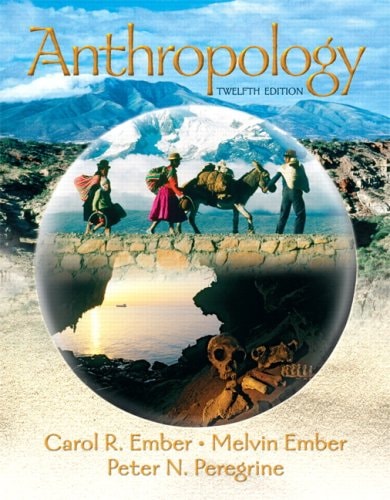
Anthropology Value Package
0
0
As an Amazon Associate and affiliate partner, Menrva Books earns from qualifying purchases. Learn more
Author Description
About the AuthorAbout the Authors Carol R. Ember started at Antioch College as a chemistry major. She began taking social science courses because some were required, but she soon found herself intrigued. There were lots of questions without answers, and she became excited about the possibility of a research career in social science. She spent a year in graduate school at Cornell studying sociology before continuing on to Harvard, where she studied anthropology primarily with John and Beatrice Whiting. For her Ph.D. dissertation she worked among the Luo of Kenya. While there she noticed that many boys were assigned "girls' work," such as babysitting and household chores, because their mothers (who did most of the agriculture) did not have enough girls to help out. She decided to study the possible effects of task assignment on the social behavior of boys. Using systematic behavior observations, she compared girls, boys who did a great deal of girls' work, and boys who did little such work. She found that boys assigned girls' work were intermediate in many social behaviors, compared with the other boys and girls. Later, she did cross-cultural research on variation in marriage, family, descent groups, and war and peace, mainly in collaboration with Melvin Ember, whom she married in 1970. All of these cross-cultural studies tested theories on data for worldwide samples of societies. From 1970 to 1996, she taught at Hunter College of the City University of New York. She has served as president of the Society of Cross-Cultural Research and was one of the directors of the Summer Institutes in Comparative Anthropological Research, which were funded by the National Science Foundation. Since 1996 she has servedas executive director of the Human Relations Area Files, Inc., a nonprofit research agency at Yale University. After graduating from Columbia College, Melvin Ember went to Yale University for his Ph.D. His mentor at Yale was George Peter Murdock, an anthropologist who w
Menrva's Summary
THE THESIS
This comprehensive textbook investigates the fundamental question of what it means to be human by examining the biological, cultural, and linguistic diversity of societies across time and space. Authored by Carol R. Ember, Melvin R. Ember, and Peter N. Peregrine, the text synthesizes decades of cross-cultural research and systematic observation to provide a rigorous framework for understanding human behavior. The authors utilize a comparative approach, drawing on data from worldwide samples of societies to test theories regarding marriage, family structures, and social evolution.
THE SCOPE MAP
What You Will Find
- Comprehensive overview of the four subfields of anthropology: biological, cultural, linguistic, and archaeology.
- Methodological tools for conducting cross-cultural research and systematic behavioral observation.
- Case studies detailing social variations in marriage, descent groups, and conflict resolution.
- Integrated digital learning components through the Anthropology Experience Student Access platform.
THE AUTHORITY PERSPECTIVE
The subject matter points to a foundational, academic-level text designed for undergraduate students seeking a structured introduction to anthropological theory and methodology. The inclusion of digital access tools suggests an emphasis on interactive learning and the practical application of ethnographic research techniques.
Page Count:
0
Publication Date:
2008-03-24
Publisher:
Prentice Hall
ISBN-10:
020565794X
ISBN-13:
9780205657940
Politics
textbook
Anthropology
Social Science
Education
Community Tags
Similar Books



Reader Comments
Share Your Thoughts
No comments yet. Be the first to share your thoughts!