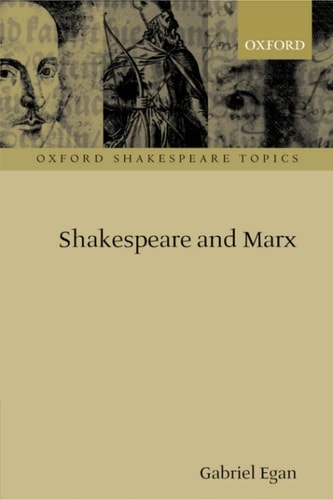
Shakespeare and Marx (Oxford Shakespeare Topics)
0
0
As an Amazon Associate and affiliate partner, Menrva Books earns from qualifying purchases. Learn more
Author Description
Marxist cultural theory underlies much teaching and research in university departments of literature and has played a crucial role in the development of recent theoretical work. Feminism, New Historicism, cultural materialism, postcolonial theory, and queer theory all draw upon ideas about cultural production which can be traced to Marx, and significantly each also has a special relation with Renaissance literary studies. This book explores the past and continuing influence of Marx's ideas in work on Shakespeare. Marx's ideas about cultural production and its relation to economic production are clearly explained, together with the standard terminology and concepts such as base/superstructure, ideology, commodity fetishism, alienation, and reification. The influence of Marx's ideas on the theory and practice of Shakespeare criticism and performance is traced from the Victorian age to the present day. The continuing importance of these ideas is illustrated via new Marxist readings of King Lear, Hamlet, The Merchant of Venice, Timon of Athens, The Comedy of Errors, All's Well that Ends Well, and The Winter's Tale.
Menrva's Summary
THE THESIS
This book investigates the historical and ongoing influence of Marxist cultural theory on the academic study and performance of William Shakespeare's works. Gabriel Egan, a scholar specializing in Shakespeare and digital humanities, provides a structured examination of how Marxist concepts—such as base/superstructure, ideology, and commodity fetishism—have shaped literary criticism from the Victorian era to the contemporary period. The text bridges the gap between abstract economic theory and specific Renaissance literary analysis to demonstrate the utility of these frameworks in modern scholarship.
THE SCOPE MAP
What You Will Find
- Explanations of core Marxist terminology including alienation, reification, and ideology.
- Historical analysis of Marxist influence on Shakespearean criticism across multiple centuries.
- Case studies applying Marxist readings to specific plays such as King Lear, Hamlet, and The Merchant of Venice.
Scope Limits
- The text focuses primarily on Marxist and materialist frameworks rather than providing a comprehensive survey of all critical theories.
- It does not offer a general biography of Shakespeare or a broad introduction to Marxist political economy outside of its literary applications.
THE AUTHORITY PERSPECTIVE
Scholars and students frequently identify this work as a clear, accessible entry point for understanding the intersection of political theory and Renaissance literature. Experts highlight the book's effectiveness in distilling complex theoretical concepts into practical tools for literary analysis.
Page Count:
176
Publication Date:
2004-01-01
Publisher:
Oxford University Press
ISBN-10:
0191514373
ISBN-13:
9780191514371
Literary Criticism
Marxist Theory
English & College Success
English
Academic
Community Tags
Similar Books