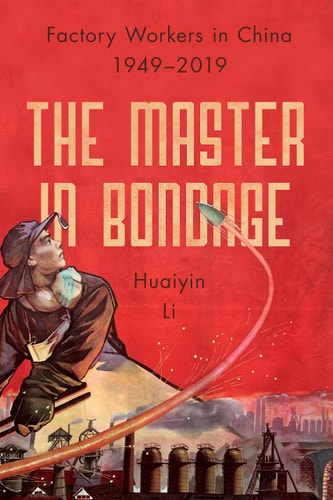
The Master in Bondage: Factory Workers in China, 1949-2019
0
0
As an Amazon Associate and affiliate partner, Menrva Books earns from qualifying purchases. Learn more
Author Description
Drawing on a rich set of original oral histories conducted with retired factory workers from industrial centers across the country, this book provides a bottom-up examination of working class participation in factory life during socialist and reform-era China. Huaiyin Li offers a series of new interpretations that challenge, revise, and enrich the existing scholarship on factory politics and worker performance during the Maoist years, including the nature of the Maoist state as seen in the operation of power relations on the shop floor, as well as the origins and dynamics of industrial enterprise reforms in the post-Mao era. In sharp contrast with the ideologically driven goal of promoting grassroots democracy or manifesting workers' status as the masters of the workplace, Li argues that Maoist era state-owned enterprises operated effectively to turn factory workers into a well-disciplined labor force through a complex set of formal and informal institutions that functioned to generate an equilibrium in power relations and work norms. The enterprise reforms of the 1980s and 1990s undermined this preexisting equilibrium, catalyzing the transformation of the industrial workforce from predominantly privileged workers in state-owned enterprises to precarious migrant workers of rural origins hired by private firms. Ultimately, this comprehensive and textured history provides an analytically astute new picture of everyday factory life in the world's largest manufacturing powerhouse.
Menrva's Summary
THE THESIS
This book examines the transformation of factory workers in China from 1949 to 2019, challenging conventional narratives of worker empowerment. Huaiyin Li utilizes original oral histories from retired factory workers to provide a bottom-up perspective on working-class participation in both socialist and reform-era China. The study argues that Maoist-era state-owned enterprises effectively created a disciplined labor force through a complex system of institutions, rather than fostering grassroots democracy. The reforms of the 1980s and 1990s disrupted this equilibrium, leading to the shift from privileged state-owned enterprise workers to precarious migrant laborers in private firms.
THE SCOPE MAP
- Oral histories from retired factory workers across China.
- Analysis of factory politics and worker performance during the Maoist era.
- Examination of power relations and work norms on the shop floor.
- Investigation into the origins and dynamics of industrial enterprise reforms.
- A study of the transformation from state-owned enterprise workers to migrant workers.
- Insights into everyday factory life in China's industrial centers.
THE AUTHORITY PERSPECTIVE
The book offers a bottom-up examination of factory workers' experiences in China, challenging existing scholarship on worker participation and state power. It posits that Maoist enterprises effectively disciplined labor rather than promoting democracy, and that subsequent reforms led to a precarious workforce. The research is grounded in extensive oral histories, providing a textured view of industrial life. This comprehensive history presents an analytically astute new picture of everyday factory life in China.
Page Count:
330
Publication Date:
2023-01-01
Publisher:
Stanford University Press
ISBN-10:
1503635287
ISBN-13:
9781503635289
Non-Fiction
History
Labor history
Social History
Sociology
Chinese History
Community Tags
Similar Books