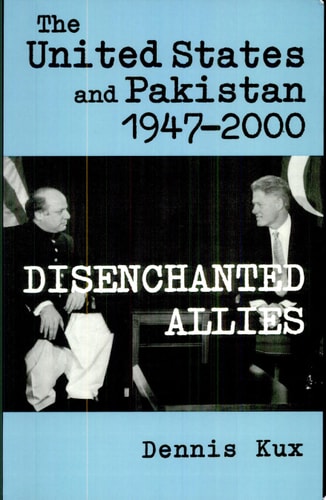
The United States and Pakistan, 1947-2000: Disenchanted Allies
0
0
As an Amazon Associate and affiliate partner, Menrva Books earns from qualifying purchases. Learn more
Author Description
Dennis Kux's book possesses a wealth of new information, based partly on fresh research in published and archival sources, but based even more impressively on the more than 100 personal interviews he conducted with former diplomats and defense officials in both the United States and Pakistan. –Robert J. McMahon, University of Florida Kux's study is, to my knowledge, the first full-dress, comprehensive, and authoritative study of U.S.-Pakistan relations. Focused primarily on formal diplomacy between these two countries, it systematically chronicles the major events, deftly handles the primary issues, and sympathetically considers the key political and diplomatic figures on both sides. –Robert Wirsing, University of South Carolina U.S.-Pakistan relations have been extraordinarily volatile, largely a function of the twists and turns of the Cold War. An intimate partnership prevailed in the Eisenhower, Nixon, and Reagan years, and friction during the Kennedy, Johnson, and Carter presidencies. Since the Cold War ended, the partnership has shriveled. The blunt talking to delivered by President Clinton to Pakistan's military dictator during Clinton's March 25, 2000, stopover in Pakistan highlighted U.S.-Pakistani differences. But the Clinton visit also underscored important U.S. interests in Pakistan. The first comprehensive account of this roller coaster relationship, this book is a companion volume to Kux's Estranged Democracies, recently called "the definitive history of Pakistani-American relations" in the New York Times.
Menrva's Summary
THE THESIS
The complex and often contradictory relationship between the United States and Pakistan, marked by periods of close alliance and significant estrangement, is chronicled from their inception in 1947 to the turn of the millennium. Dennis Kux, drawing on extensive interviews with diplomats and defense officials from both nations, meticulously details the shifting dynamics of this alliance, largely shaped by the geopolitical currents of the Cold War. The book examines how periods of intimate partnership under administrations like Eisenhower's and Reagan's contrasted with periods of friction during the Kennedy and Carter years, ultimately leading to a diminished partnership after the Cold War's end.
THE SCOPE MAP
- A comprehensive chronicle of U.S.-Pakistan formal diplomatic relations from 1947 to 2000.
- Analysis of how Cold War dynamics influenced the alliance, creating periods of both close partnership and friction.
- Exploration of key political and diplomatic figures on both sides of the relationship.
- Insights derived from over 100 personal interviews with former diplomats and defense officials.
- Examination of the post-Cold War shriveling of the partnership and its implications.
- Discussion of U.S. interests in Pakistan, highlighted by events such as President Clinton's 2000 visit.
THE AUTHORITY PERSPECTIVE
Robert J. McMahon of the University of Florida notes the book's wealth of new information derived from fresh research and over 100 interviews. Robert Wirsing of the University of South Carolina identifies Kux's study as the first comprehensive and authoritative account of U.S.-Pakistan relations, praising its systematic chronicle of events and handling of primary issues. The book is positioned as a companion to Kux's "Estranged Democracies," which was lauded by The New York Times as the definitive history of Pakistani-American relations. The reception highlights the book's depth, authoritativeness, and unique access to primary sources.
Page Count:
470
Publication Date:
2001-06-05
Publisher:
Woodrow Wilson Center Press
ISBN-10:
0801865727
ISBN-13:
9780801865725
Non-Fiction
History
International relations
Community Tags
Similar Books