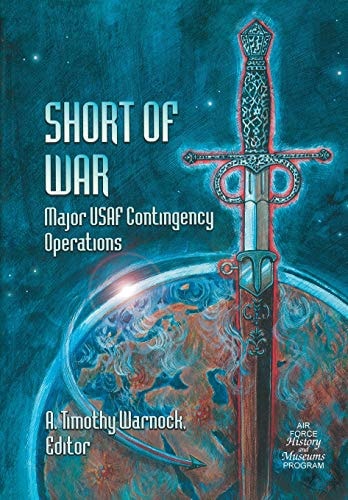
Short of War: Major US Contingency Operations 1947-1997
0
0
As an Amazon Associate and affiliate partner, Menrva Books earns from qualifying purchases. Learn more
Author Description
First published in 2000. From the foreword: "Since the fall of the Berlin Wall, a series of geographically localized crises caused by political, religious, or ethnic unrest; outright military aggression; and natural disasters has replaced the relative stability that characterized international relations for more than fifty years of the Cold War. For the United States Air Force (USAF), this has meant short-notice deployments, airlifts, and other operational missions conducted in reaction to local crises. Such missions-once of secondary importance to nuclear deterrence or preparations for theater war-have come to dominate Air Force operations. The result has been recognition that global aerospace power and mobility are central to effective American crisis intervention in the post-Cold War world. This recognition has led the U.S. Air Force to restructure itself as an Expeditionary Aerospace Force, exploiting diverse core competencies consisting of global air and space superiority, rapid global mobility, precision engagement, global attack, information superiority, and agile combat support. Via rapid-response air expeditionary forces, the U.S. Air Force can furnish global power and presence for humanitarian or combat purposes-"bombs or bread or both"-in hours to any spot on Earth. A traditional precept of USAF doctrine has been that the service must always be prepared to assess its roles and missions in light of new and ever-changing national policy and strategy. Recognizing that doctrine is largely a distillation of knowledge gained from historical experience, the Air Force Historical Research Agency has compiled this record of USAF contingency operations covering the last half-century. This book is an effort to meet the needs of Air Force commanders and other decision makers for a useful reference work on contingencies. One of an ongoing series of reference works, it is organized in the style of the recently published The United States Air Force and Humanitarian Airlift."
Menrva's Summary
THE THESIS
The United States Air Force's role in global crisis intervention has evolved significantly from its Cold War focus on nuclear deterrence to its post-Cold War emphasis on rapid, expeditionary operations. This book chronicles major U.S. contingency operations undertaken by the Air Force between 1947 and 1997, a period marked by the transition from a bipolar world to one of localized conflicts and natural disasters. It serves as a reference for commanders and decision-makers, detailing how the USAF has adapted its capabilities, such as global mobility and precision engagement, to meet the demands of crisis intervention, whether for humanitarian or combat purposes.
THE SCOPE MAP
- A comprehensive record of U.S. Air Force contingency operations from 1947 to 1997.
- Analysis of the shift in USAF operational focus from Cold War deterrence to post-Cold War crisis intervention.
- Case studies of airlifts and other operational missions conducted in reaction to local crises.
- Exploration of the USAF's restructuring into an Expeditionary Aerospace Force.
- Discussion of core competencies including global air and space superiority, rapid global mobility, and precision engagement.
- Examples of "bombs or bread or both" delivered via rapid-response air expeditionary forces.
- Historical experience as a foundation for USAF doctrine and strategy.
THE AUTHORITY PERSPECTIVE
This volume is presented as a vital reference work for U.S. Air Force commanders and decision-makers, compiled by the Air Force Historical Research Agency to distill historical experience into actionable doctrine. Its organization follows that of other reference works, suggesting a systematic and archival approach to presenting information on contingency operations. The book aims to provide a foundational understanding of the USAF's evolving roles and missions in response to changing national policy and strategy, particularly in the context of post-Cold War global challenges.
Page Count:
306
Publication Date:
2013-07-01
Publisher:
Military Studies Press
ISBN-10:
1782664327
ISBN-13:
9781782664321
History
Non-Fiction
Military History
Aviation History
Community Tags
Similar Books