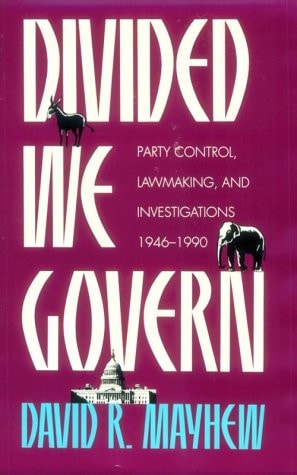
Divided We Govern: Party Control, Lawmaking, and Investigations, 1946-1990
0
0
As an Amazon Associate and affiliate partner, Menrva Books earns from qualifying purchases. Learn more
Author Description
Conventional wisdom has assumed that US national government functions more effectively when one party controls both the presidency and Congress, yet divided governments are increasingly the norm. The author looks at this issue and concludes that control by one party has made little difference.
Menrva's Summary
THE THESIS
This book challenges the conventional wisdom that unified party control of the US government leads to more effective governance. David R. Mayhew, a distinguished political scientist, examines the period from 1946 to 1990, a time marked by increasing instances of divided government where the presidency and Congress are controlled by different parties. Despite the common assumption that such divisions hinder legislative productivity and oversight, Mayhew's analysis of lawmaking and investigations suggests that unified party control has made little discernible difference in the government's overall effectiveness.
THE SCOPE MAP
- Analysis of legislative productivity and investigative activities during periods of unified and divided government.
- Examination of the period between 1946 and 1990, covering multiple presidential and congressional control shifts.
- Empirical data on lawmaking outcomes under different party control scenarios.
- Assessment of the impact of party control on the effectiveness of government investigations.
- Argument that unified party control does not necessarily lead to more effective governance.
- Focus on the structural and institutional factors influencing government performance beyond party alignment.
THE AUTHORITY PERSPECTIVE
The book's central argument, that divided government does not significantly impede governmental effectiveness, offers a counterpoint to prevailing assumptions in political science. Mayhew's rigorous empirical approach, focusing on concrete measures of lawmaking and investigations, provides a data-driven foundation for his conclusions. The work is likely to be of interest to scholars and students of American politics, legislative behavior, and comparative government. Its findings suggest a need to re-evaluate the perceived benefits of party unity in the US federal system.
Page Count:
228
Publication Date:
1991-01-01
Publisher:
Yale University Press
ISBN-10:
0300048351
ISBN-13:
9780300048353
Politics
Non-Fiction
History
US Government
Legislative Process
American Politics
Community Tags
Similar Books