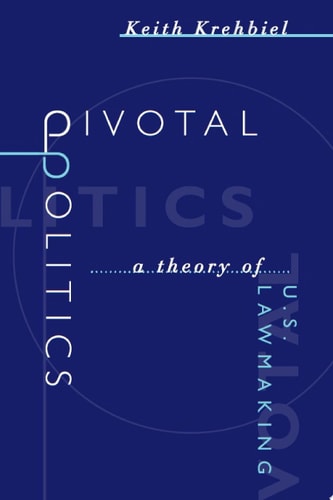
Pivotal Politics
0
0
As an Amazon Associate and affiliate partner, Menrva Books earns from qualifying purchases. Learn more
Author Description
Politicians and pundits alike have complained that the divided governments of the last decades have led to legislative gridlock. Not so, argues Keith Krehbiel, who advances the provocative theory that divided government actually has little effect on legislative productivity. Gridlock is in fact the order of the day, occurring even when the same party controls the legislative and executive branches. Meticulously researched and anchored to real politics, Krehbiel argues that the pivotal vote on a piece of legislation is not the one that gives a bill a simple majority, but the vote that allows its supporters to override a possible presidential veto or to put a halt to a filibuster. This theory of pivots also explains why, when bills are passed, winning coalitions usually are bipartisan and supermajority sized. Offering an incisive account of when gridlock is overcome and showing that political parties are less important in legislative-executive politics than previously thought, Pivotal Politics remakes our understanding of American lawmaking.
Menrva's Summary
THE THESIS
This book challenges the conventional wisdom that divided government is the primary cause of legislative gridlock. Keith Krehbiel argues that legislative productivity is not significantly affected by whether the same party controls both the legislative and executive branches. Instead, he posits that gridlock is a constant feature of American lawmaking, occurring even when unified party control exists. The book's central thesis is that the pivotal votes are not those for a simple majority, but those required to overcome a presidential veto or break a filibuster, explaining the prevalence of bipartisan, supermajority coalitions when legislation does pass.
THE SCOPE MAP
- Analysis of legislative productivity in American government.
- Theory of 'pivotal votes' in lawmaking, distinguishing between simple majority and veto-override/filibuster-proof thresholds.
- Examination of legislative gridlock and its causes, challenging the focus on divided government.
- Explanation for the formation of bipartisan and supermajority coalitions.
- Assessment of the role of political parties in legislative-executive politics.
- Empirical data and real-world political examples to support the theoretical framework.
- Remakes the understanding of the American lawmaking process.
THE AUTHORITY PERSPECTIVE
The book presents a provocative theory that challenges established notions of legislative gridlock, suggesting that divided government has minimal impact on legislative productivity. It meticulously researches real political dynamics to argue that gridlock is a persistent condition, even under unified party control. The work is noted for its incisive account of how and when gridlock is overcome, and for its reevaluation of the importance of political parties in the legislative-executive relationship. This analysis aims to fundamentally alter the understanding of American lawmaking.
Page Count:
274
Publication Date:
2010-05-27
Publisher:
University of Chicago Press
ISBN-10:
0226452735
ISBN-13:
9780226452739
Non-Fiction
Politics
Government
American Politics
Legislative Process
Community Tags
Similar Books