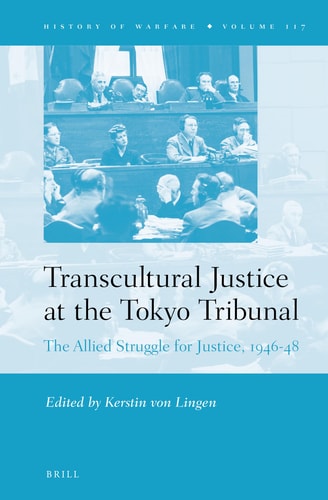
Transcultural Justice at the Tokyo Tribunal: The Allied Struggle for Justice, 1946-48
0
0
As an Amazon Associate and affiliate partner, Menrva Books earns from qualifying purchases. Learn more
Author Description
While the International Military Tribunal at Nuremberg has been at the centre of scholarly attention, the Tokyo Tribunal has for decades been largely neglected. This is surprising insofar as this tribunal was a well-organized Allied endeavour and prefigured the international courts and tribunals of our day. Eleven national teams were sent to Tokyo between 1946 and 1948 to bring about justice in the aftermath of the Pacific War. This volume offers an innovative approach to the Tokyo Tribunal as an arena of transcultural engagement. It contextualizes legal agents as products of transnational forces, constituted through dialogues about legal concepts and processes of faction-making. The endeavour was challenged by different national policies, divergent legal traditions, and varying cultural perceptions of the task ahead. Contributors are Milinda Banerjee, Anja Bihler, Neil Boister, David M. Crowe, Kerstin von Lingen, Narrelle Morris, Hitoshi Nagai, Valentyna Polunina, Ann-Sophie Schoepfel, Lisette Schouten, James Burnham Sedgwick, Yuki Takatori and Urs Matthias Zachmann.
Menrva's Summary
THE THESIS
The Tokyo Tribunal, a crucial but often overlooked Allied endeavor following the Pacific War, is examined as a complex arena of transcultural legal engagement. This volume investigates the International Military Tribunal for the Far East, which operated between 1946 and 1948, contrasting its scholarly neglect with its significance as a precursor to modern international courts. It explores how eleven national teams navigated differing national policies, legal traditions, and cultural perceptions to administer justice. The book presents legal agents as products of transnational forces, shaped by dialogues on legal concepts and internal faction-making processes.
THE SCOPE MAP
- Analysis of the International Military Tribunal for the Far East (Tokyo Tribunal) and its historical context.
- Exploration of the tribunal as an arena of transcultural engagement.
- Examination of legal agents as products of transnational forces.
- Discussion of the challenges posed by divergent national policies, legal traditions, and cultural perceptions.
- Contextualization of the tribunal's role in the aftermath of the Pacific War.
- Contributions from eleven national teams between 1946 and 1948.
THE AUTHORITY PERSPECTIVE
This volume offers an innovative approach to the Tokyo Tribunal, positioning it as a significant site of transcultural legal engagement. The contributors analyze the tribunal's operations by contextualizing legal agents within transnational forces and dialogues on legal concepts. The work highlights the inherent challenges arising from diverse national policies, legal traditions, and cultural viewpoints that shaped the proceedings. By focusing on this often-neglected aspect of post-war justice, the book provides a nuanced perspective on international law and its application.
Page Count:
314
Publication Date:
2018-01-01
Publisher:
Brill
ISBN-10:
9004359974
ISBN-13:
9789004359970
History
Non-Fiction
Law
International relations
Community Tags
Similar Books