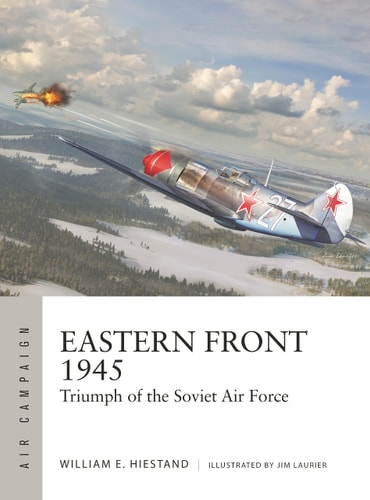
Eastern Front 1945: Triumph of the Soviet Air Force
0
0
As an Amazon Associate and affiliate partner, Menrva Books earns from qualifying purchases. Learn more
Author Description
A detailed, illustrated account of the air campaign that accompanied the Red Army's final push towards Berlin, in which massed Soviet air power defeated the Luftwaffe's high-tech Me 262 jets and Mistel exploding drones. The last months of World War II on the Eastern Front saw a ferocious fight between two very different air forces. Soviet Air Force (VVS) Commander-in-Chief Alexander Novikov assembled 7,500 aircraft in three powerful air armies to support the final assault on Berlin. The Luftwaffe employed some of its most advanced weapons including the Me 262 jet and Mistel remotely-guided bomb aircraft. Using photos, 3D diagrams, maps and battlescene artwork, William E. Hiestand, a military analyst with a longstanding interest in Soviet military history, explains how Germany's use of high-tech weaponry and massed Soviet air assaults was not just the culmination of World War II air combat, but also pointed to how the future rivalry with NATO would play out. The VVS used powerful and flexible air armies to control and employ its huge force of aircraft – organizational and employment concepts that would shape Soviet plans and preparations for combat during the Cold War. For the first time, this volume explains how air power helped win the war on the Eastern Front, and how victory shaped Soviet air power doctrine for the decades to come.
Menrva's Summary
THE THESIS
This book details the pivotal air campaign of the Eastern Front in 1945, focusing on the Soviet Air Force's decisive role in the final assault on Berlin. It examines the clash between the massed Soviet air power, comprising 7,500 aircraft under Alexander Novikov, and the Luftwaffe's advanced weaponry, including the Me 262 jet and Mistel drones. The author, William E. Hiestand, a military analyst with expertise in Soviet military history, uses a wealth of visual and textual evidence to explain how this conflict not only marked the culmination of WWII air combat but also foreshadowed future aerial strategies against NATO. The organizational and employment concepts of the Soviet air armies are explored for their lasting impact on Cold War doctrine.
THE SCOPE MAP
- Detailed account of the air campaign accompanying the Red Army's final push towards Berlin.
- Analysis of the Soviet Air Force's (VVS) deployment of 7,500 aircraft in three powerful air armies.
- Examination of the Luftwaffe's advanced weaponry, including the Me 262 jet and Mistel remotely-guided bomb aircraft.
- Use of photos, 3D diagrams, maps, and battlescene artwork to illustrate the conflict.
- Explanation of how Soviet air power contributed to victory on the Eastern Front.
- Discussion of how the VVS's organizational and employment concepts shaped Soviet air power doctrine for the Cold War.
- Military analyst William E. Hiestand's perspective on the historical significance of the air combat.
THE AUTHORITY PERSPECTIVE
The book is presented as a detailed, illustrated account by military analyst William E. Hiestand, who has a longstanding interest in Soviet military history. It aims to explain for the first time how air power was instrumental in the Soviet victory on the Eastern Front and how this victory influenced Soviet air power doctrine for decades. The work utilizes a range of visual aids, including photos, 3D diagrams, maps, and artwork, to support its analysis of the air campaign and the technological disparities between the Soviet and German air forces. The author's background suggests a focus on strategic and operational aspects of air warfare during the final months of World War II.
Page Count:
96
Publication Date:
2024-01-16
Publisher:
Bloomsbury USA
ISBN-10:
1472857828
ISBN-13:
9781472857828
Non-Fiction
History
Soviet Union
Aviation History
Military History
Community Tags
Similar Books