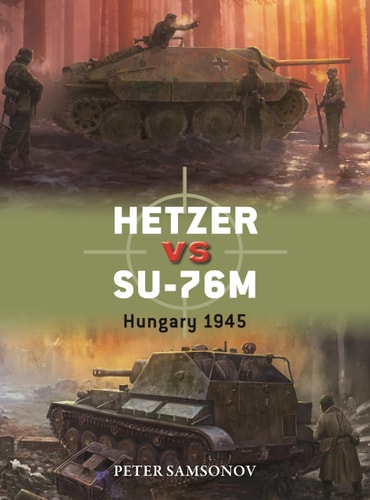
Hetzer Vs SU-76M Hungary 1945
0
0
As an Amazon Associate and affiliate partner, Menrva Books earns from qualifying purchases. Learn more
Author Description
A noted authority examines the roles played by Germany's Hetzer tank destroyer and the Soviet SU-76M self-propelled gun during the battle for Hungary in 1945. During World War II, Germany and the Soviet Union soon found that their light tanks were obsolete; while their small guns were no longer useful against the enemy's armoured vehicles, the chassis allowed for installation of a larger gun at the cost of a rotating turret. Keen to utilize existing technology, Germany and the Soviet Union approached this challenge differently. While the Germans turned their PzKpfw 38(t) tank into a tank destroyer, first the open-topped Marder III and then the fully enclosed Jagdpanzer 38(t), nicknamed the 'Hetzer', the Soviet designers turned the T-70 light tank into an infantry support gun capable of engaging enemy armour, its open-topped fighting compartment adding communication with accompanying infantry. In this study, leading armour expert Peter Samsonov's insightful analysis is complemented by specially commissioned artwork and mapping alongside carefully selected archive and present-day photographs, revealing the origins, development and combat performance of these two types at war. Both were widely employed amid the tank battles of early 1945, as Soviet forces reached deep into Hungary and the Axis armies mounted one last counter-offensive on the Eastern Front, Operation Spring Awakening.
Menrva's Summary
THE THESIS
This book examines the contrasting design philosophies and combat effectiveness of the German Hetzer tank destroyer and the Soviet SU-76M self-propelled gun during the intense fighting in Hungary in early 1945. As World War II progressed, both Germany and the Soviet Union faced the obsolescence of their light tanks, leading them to adapt existing chassis for larger guns, albeit with different approaches to turret design and operational roles. The Hetzer, a fully enclosed tank destroyer, and the SU-76M, an open-topped infantry support gun, were widely deployed in the final major German offensive on the Eastern Front, Operation Spring Awakening, and the subsequent Soviet advance.
THE SCOPE MAP
- Origins and development of the Jagdpanzer 38(t) 'Hetzer' and the SU-76M.
- Comparative analysis of their design features, including turret configuration and armament.
- Examination of their roles in infantry support and anti-armor combat.
- Detailed account of their deployment during the battles for Hungary in 1945.
- Analysis of their performance amidst Operation Spring Awakening and the Eastern Front battles.
- Inclusion of specially commissioned artwork, maps, and archive/present-day photographs.
THE AUTHORITY PERSPECTIVE
This study by armor expert Peter Samsonov offers an insightful analysis of two distinct armored fighting vehicles employed during a critical phase of World War II. The book is expected to provide a detailed comparison of their design, development, and combat performance, utilizing a range of visual and archival materials. Its focus on the Hungarian theater in 1945 situates these vehicles within the context of major offensives on the Eastern Front.
Page Count:
80
Publication Date:
2025-12-16
Publisher:
Bloomsbury USA
ISBN-10:
147286610X
ISBN-13:
9781472866103
Non-Fiction
History
Armor
Vehicles
Military History
Community Tags
Similar Books