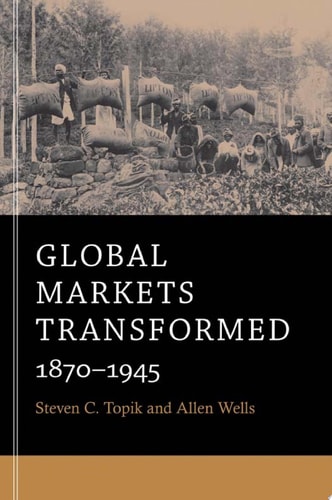
Global Markets Transformed 1870–1945
0
0
As an Amazon Associate and affiliate partner, Menrva Books earns from qualifying purchases. Learn more
Author Description
Offering a fresh look at trade during the second industrial revolution, Global Markets Transformed describes a world of commodities on the move—wheat and rice, coffee and tobacco, oil and rubber, all jostling around the planet through a matrix of producers, processors, transporters, and buyers. Steven C. Topik and Allen Wells discuss how innovations in industrial and agricultural production, transportation, commerce, and finance transformed the world economy from 1870 to 1945. Topik and Wells trace the evolution of global chains of commodities, from basic food staples and stimulants to strategically important industrial materials, that linked the agricultural and mineral-producing areas of Latin America, Asia, and Africa to European and North American consumers and industrialists. People living a great distance apart became economically intertwined as never before. Yet laborers and consumers at opposite ends of commodity chains remained largely invisible to one another. Affluent American automobile owners who were creating the skyrocketing demand for tires, for example, knew almost nothing about poor Brazilian tappers who sweated in the Amazon to supply the rubber necessary for their vehicles. As commodity chains stretched out around the world, more goods were bound up in markets that benefited some countries more than others. Global Markets Transformed highlights the lessons and legacy of the early years of globalization—when the world’s population doubled, trade quadrupled, industrial output multiplied fivefold, and the gap between rich and poor regions grew ever wider.
Menrva's Summary
THE THESIS
The book investigates how global commodity markets were transformed by the second industrial revolution, linking disparate regions through trade while widening economic disparities. The authors, Steven C. Topik and Allen Wells, examine the movement of commodities like wheat, rice, coffee, tobacco, oil, and rubber across the globe between 1870 and 1945. They detail how innovations in production, transportation, commerce, and finance reshaped the world economy, creating intricate chains from agricultural and mineral producers in Latin America, Asia, and Africa to consumers and industrialists in Europe and North America. The work highlights the growing economic interdependence alongside the increasing invisibility of laborers and consumers to one another, and the widening gap between rich and poor regions.
THE SCOPE MAP
- Analysis of commodity chains for staples (wheat, rice), stimulants (coffee, tobacco), and industrial materials (oil, rubber).
- Examination of innovations in industrial and agricultural production, transportation, commerce, and finance.
- Tracing the evolution of global economic links between producing regions (Latin America, Asia, Africa) and consuming regions (Europe, North America).
- Discussion of the social and economic consequences of globalization, including increased interdependence and growing inequality.
THE AUTHORITY PERSPECTIVE
The book is recognized for its fresh perspective on trade during the second industrial revolution, detailing the complex global commodity chains that emerged between 1870 and 1945. It highlights how economic globalization intertwined distant populations while simultaneously increasing the gap between affluent and impoverished regions. The work is noted for its examination of the lessons and legacy of this early period of globalization, characterized by significant population growth, trade expansion, and industrial output increase.
Page Count:
336
Publication Date:
2014-04-21
Publisher:
Harvard University Press
ISBN-10:
0674281349
ISBN-13:
9780674281349
History
Non-Fiction
Economics
Global History
Community Tags
Similar Books