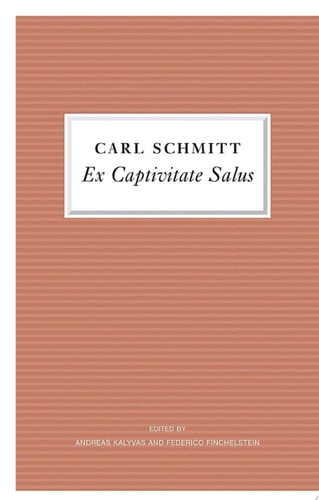
Ex Captivitate Salus: Experiences, 1945-47
0
0
As an Amazon Associate and affiliate partner, Menrva Books earns from qualifying purchases. Learn more
Author Description
When Germany was defeated in 1945, both the Russians and the Americans undertook mass internments in the territories they occupied. The Americans called their approach "automatic arrest." Carl Schmitt, although not belonging in the circles subject to automatic arrest, was held in one of these camps in the years 1945–6 and then, in March 1947, in the prison of the international tribunal in Nuremberg, as witness and "possible defendant." A formal charge was never broughtagainsthim. Schmitt's way of coping throughout the years of isolation was to write this book. In Ex Captivitate Salus, or Deliverance from Captivity, Schmitt considers a range of issues relating to history and political theoryas well as recent events, including the Nazi defeat and the newly emerging Cold War. Schmitt often urged his readers to view the book as though?it were a series of letters personally directed to each one of them. Hence there is a decidedly personal dimension to the text, as Schmitt expresses his thoughts on his own career trajectory with some pathos, while at the same time emphasising that "this is not romantic or heroic prison literature." This reflective work sheds new light on Schmitt's thought and personal situation at the beginning of a period of exile from public life that only ended with his death in 1985. It will be of great value to the many students and scholars in political theory and law who continue to study and appreciate this seminal theorist of the twentieth century.
Menrva's Summary
THE THESIS
Carl Schmitt reflects on his internment and the shifting geopolitical landscape following Germany's defeat. Following his internment by American forces after World War II and his subsequent detention in Nuremberg, Carl Schmitt, a prominent legal and political theorist, penned this work during his isolation. The book, titled 'Deliverance from Captivity,' explores a wide array of historical and political theories, alongside contemporary events such as the Nazi regime's collapse and the nascent Cold War. Schmitt intended the text to be read as a personal address, imbuing it with a distinct personal dimension where he contemplates his own career with a degree of pathos, while consciously distancing it from conventional prison literature.
THE SCOPE MAP
- Analysis of historical events and political theory from the perspective of an internee.
- Schmitt's personal reflections on his career trajectory and public life.
- Consideration of the immediate post-war political climate, including the Nazi defeat and the emerging Cold War.
- An examination of the American 'automatic arrest' policy and internment camps.
- Schmitt's experience as a witness and potential defendant at the Nuremberg tribunal.
- The book's structure as a series of personal letters to the reader.
- Schmitt's deliberate avoidance of romantic or heroic prison literature tropes.
THE AUTHORITY PERSPECTIVE
This reflective work offers significant insight into Carl Schmitt's intellectual development and personal circumstances during a period of enforced public silence. The book is valued by students and scholars of political theory and law for its unique perspective from a seminal 20th-century thinker. It provides a rare glimpse into Schmitt's thought process as he grappled with his own legacy and the dramatic global shifts occurring around him. The text is particularly notable for its personal tone, framed as direct correspondence with the reader, while maintaining a rigorous intellectual engagement with historical and theoretical issues.
Page Count:
120
Publication Date:
2017-10-16
Publisher:
Polity Press
ISBN-10:
1509511679
ISBN-13:
9781509511679
Non-Fiction
Biography
Memoir
History
Political Theory
Law
Community Tags
Similar Books