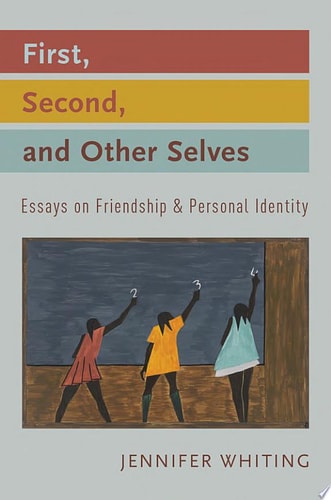
First, Second, and Other Selves: Essays on Friendship and Personal Identity
0
0
As an Amazon Associate and affiliate partner, Menrva Books earns from qualifying purchases. Learn more
Author Description
In her essay collection First, Second, and Other Selves: Essays on Friendship and Personal Identity, well-known scholar of ancient philosophy Jennifer Whiting gathers her previously published essays taking Aristotle's theories on friendship as a springboard to engage with contemporary philosophical work on personal identity and moral psychology. Whiting examines three themes throughout the collection, the first being psychic contingency, or the belief that the psychological structures characteristic of human beings may in fact vary, not just from one cultural (or socio-historical) context to another, but also from one individual to another. The second theme is the belief that friendship informs an understanding of the nature of the self, an idea that springs from Whiting's uncommon reading of Aristotle's writings on friendship. Specifically, Whiting explains a scenario in which a "virtuous agent" adopts a kind of impersonal attitude both towards herself and towards her "character" friends, loving both because they are virtuous; this scenario ties in with an examination of the Aristotelian concept of the ideal friend as an "other self," or a friendship that evolves from character rather than ego, as well as Whiting's meditation on whether or not a virtuous individual should have a "special" sort of concern for her own future self, distinct in kind from the concern that she has for others. The third theme is that of rational egoism, a concept that Whiting critiques, especially in the context of Aristotle's eudaimonism. The central tenet of the collection is the message that taking "ethocentric" (or character-based) attitudes both towards ourselves and towards our friends sheds light on the nature of personal identity and helps to combat ethnocentric and other objectionable forms of bias, a message that is becoming increasingly urgent in light of the recent deaths of Trayvon Martin and Michael Brown.
Menrva's Summary
THE THESIS
This collection investigates how Aristotelian theories of friendship can be utilized to reframe contemporary understandings of personal identity, moral psychology, and the nature of the self. Jennifer Whiting, a scholar of ancient philosophy, synthesizes her previously published academic work to argue that character-based, or 'ethocentric,' attitudes provide a robust framework for navigating moral concerns. By critiquing rational egoism and exploring psychic contingency, she proposes that our relationships with others are fundamental to defining our own identity.
THE SCOPE MAP
What You Will Find
- Analysis of Aristotelian eudaimonism and its application to modern moral dilemmas.
- Exploration of 'psychic contingency' regarding the variability of human psychological structures.
- Examination of the 'other self' concept in the context of virtuous friendship.
Scope Limits
- The text focuses primarily on Aristotelian frameworks and may not address non-Western philosophical traditions in depth.
- The collection is comprised of previously published essays rather than a singular, linear narrative argument.
THE AUTHORITY PERSPECTIVE
Scholars and students of moral philosophy frequently identify this work as a significant contribution to the intersection of ancient ethics and contemporary identity theory. Readers often note the academic density of the prose, which requires a foundational understanding of Aristotelian concepts to fully grasp the author's nuanced arguments.
Page Count:
280
Publication Date:
2016-01-01
Publisher:
Oxford University Press
ISBN-10:
0190631716
ISBN-13:
9780190631710
Philosophy
Aristotle
Essays
Ethics
Plato
Personal Identity
History & Surveys
Self Philosophy
Community Tags
Similar Books