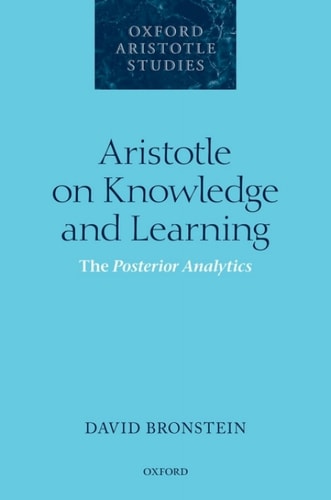
Aristotle on Knowledge and Learning: The Posterior Analytics
0
0
As an Amazon Associate and affiliate partner, Menrva Books earns from qualifying purchases. Learn more
Author Description
'All teaching and all intellectual learning come to be from pre-existing knowledge.' So begins Aristotle's Posterior Analytics, one of the most important, and difficult, works in the history of western philosophy. David Bronstein sheds new light on this challenging text by arguing that it is coherently structured around two themes of enduring philosophical interest: knowledge and learning. The Posterior Analytics, on Bronstein's reading, is a sustained examination of scientific knowledge: what it is and how it is acquired. Aristotle first discusses two principal forms of scientific knowledge (epist?m? and nous). He then provides a compelling account, in reverse order, of the types of learning one needs to undertake in order to acquire them. The Posterior Analytics thus emerges as an elegantly organized work in which Aristotle describes the mind's ascent from sense-perception of particulars to scientific knowledge of first principles. Bronstein also highlights Plato's influence on Aristotle's text. For each type of learning Aristotle discusses, Bronstein uncovers an instance of Meno's Paradox (a puzzle from Plato's Meno according to which inquiry and learning are impossible) and a solution to it. In addition, he argues, against current orthodoxy, that Aristotle is committed to the Socratic Picture of inquiry, according to which one should seek what a thing's essence is before seeking its demonstrable attributes and their causes. Aristotle on Knowledge and Learning will be of interest to students and scholars of ancient philosophy, epistemology, or philosophy of science.
Menrva's Summary
THE THESIS
This book investigates the core question of how Aristotle structures his inquiry into the nature of scientific knowledge and the processes required to attain it. David Bronstein, a scholar of ancient philosophy, utilizes a close reading of the Posterior Analytics to argue that the text is a cohesive examination of episteme and nous. He posits that Aristotle organizes the work around the mind's progression from sense-perception to the grasp of first principles, while simultaneously addressing the influence of Platonic paradoxes on Aristotelian methodology.
THE SCOPE MAP
What You Will Find
- An analysis of the two primary forms of scientific knowledge: episteme and nous.
- A detailed examination of the learning processes required to acquire scientific knowledge.
- A comparative study of Aristotle's engagement with Plato's Meno's Paradox.
- An argument regarding Aristotle's commitment to the Socratic Picture of inquiry.
Scope Limits
- The text focuses specifically on the Posterior Analytics rather than a comprehensive survey of the entire Aristotelian corpus.
- It does not provide a general introduction to ancient philosophy for those without prior exposure to the subject matter.
THE AUTHORITY PERSPECTIVE
Scholars and students of ancient philosophy recognize this work as a significant contribution to the interpretation of Aristotle's scientific methodology. Readers frequently note the academic density of the prose, which is intended for those already familiar with the complexities of Aristotelian epistemology.
Page Count:
272
Publication Date:
2016-01-01
Publisher:
OUP Oxford
ISBN-10:
0191037915
ISBN-13:
9780191037917
Philosophy
History & Surveys
Knowledge Theory
Aristotle
Epistemology
Philosophy of
Community Tags
Similar Books