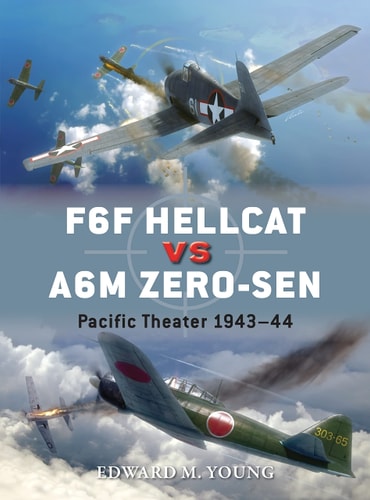
F6F Hellcat vs A6M Zero-sen Pacific Theater 1943–44
0
0
As an Amazon Associate and affiliate partner, Menrva Books earns from qualifying purchases. Learn more
Author Description
In the key Pacific War battles of the Marianas Turkey Shoot, Leyte Gulf, and in and around Japan itself (from late 1943 through to VJ-Day) the principal fighters involved were the F6F Hellcat and the A6M5/7 Zero-sen. The former was Grumman's successor to the pugnacious Wildcat, and its creation was shaped by the combat experiences of Naval Aviators flying the F4F against the A6M2/3 Zero-sen from late 1941. Blooded in combat against the Japanese in August 1943, the Hellcat went on to serve as the principal US Navy fighter on board carrier decks until war's end. Despite its lethality in the air when ranged against the best Japanese fighters, the Hellcat still retained docile handling qualities around the carrier deck. Naval Aviators flying the Hellcat claimed in excess of 5,000 kills in the Pacific, and more than 300 pilots achieved ace status on the type. The majority of these victories took the form of A6M5 Zero-sens, the most-produced model of the final Mitsubishi fighter - some 6000 were built from late 1943 through to war's end. The A6M5 reached front-line units just as the Hellcat was making its combat debut, the new version of the Zero-sen being based on the previous A6M3 model but with modified flaps and ailerons and thickened wing skinning. It was only meant to be an interim design pending the arrival of the A7M Reppu and J2M Raiden. However, terminal development problems with the former and technical issues with the latter meant that the A6M5, and re-engined limited run A6M7 (150 built), had to hold the line through to September 1945. By now badly outclassed by the Hellcat, literally thousands of Zero-sens fell victim to US Navy fighter squadrons in the final years of the war.
Menrva's Summary
THE THESIS
This book investigates the aerial combat effectiveness and historical significance of the F6F Hellcat and the A6M Zero-sen during the crucial latter years of the Pacific Theater in World War II. It examines how these two principal fighter aircraft, representing the peak of American carrier-based fighter design and the final iterations of Japan's iconic naval fighter, performed in key battles from late 1943 through to the war's end. The analysis focuses on their design evolution, combat performance, and the impact of their encounters on the course of the war in the Pacific.
THE SCOPE MAP
- Detailed comparison of the F6F Hellcat and A6M5/7 Zero-sen fighter aircraft.
- Analysis of their performance in major Pacific War battles including the Marianas Turkey Shoot, Leyte Gulf, and operations around Japan.
- Examination of the design lineage and combat experiences that shaped both aircraft.
- Data on claimed aerial victories and pilot achievements for the F6F Hellcat.
- Discussion of the Zero-sen's role as an interim design and its eventual obsolescence against superior Allied aircraft.
- Coverage of the A6M5's development and its final variants (A6M7) that held the line for Japan.
THE AUTHORITY PERSPECTIVE
This work is positioned as a detailed historical account for enthusiasts of military aviation and World War II history. Its focus on specific aircraft types and their comparative performance in key engagements suggests a deep dive into technical specifications and tactical engagements. The author's approach likely provides a thorough analysis for readers interested in the operational history and technological evolution of naval aviation during the latter stages of the Pacific War.
Page Count:
80
Publication Date:
2014-08-19
Publisher:
Bloomsbury USA
ISBN-10:
1782008136
ISBN-13:
9781782008132
Non-Fiction
History
Aviation History
Military History
Community Tags
Similar Books