New Guinea 1942–43
0
0
As an Amazon Associate and affiliate partner, Menrva Books earns from qualifying purchases. Learn more
Author Description
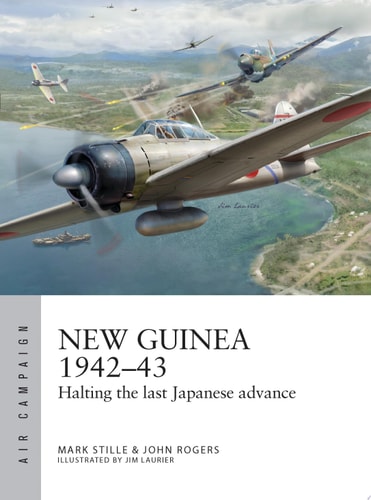
Lavishly illustrated, this book studies the role of airpower in the New Guinea battles of 1942–43, as the Allies checked and halted Japan's last significant offensives. Mark Stille and John Rogers offer a new history of a previously neglected part of the South Pacific air war - the battles over New Guinea and the waters around it. The first of two books on the subject, drawing on Japanese, American and Australian sources, it details operations from February 1942 until April 1943, which saw the Allies stop the last Japanese efforts to expand their faltering empire. Allied air operations focused on denying the Japanese the use of the sea to send reinforcements to New Guinea, during the battles for Buna and Gona, the unsuccessful and little-known Japanese invasion at Milne Bay, and the Battle of the Bismarck Sea in which a major Japanese effort to move troops to New Guinea was crushed by air power. While the Japanese had over-extended and lost operational focus, the Allies were successful in interdicting sea movement of Japanese forces to New Guinea. However, immature tactics meant air power was largely ineffective supporting their ground campaign. Packed with photos, superb original battlescenes, 3D diagrams and maps, this book explains the roles of Japanese and Allied air power in the crucial battle of New Guinea.
Menrva's Summary
THE THESIS
This book investigates the critical role of airpower in the New Guinea campaigns of 1942–43, examining how Allied air superiority halted Japanese expansion in the South Pacific. Authors Mark Stille and John Rogers present a new history of this often-overlooked theater of the air war, drawing on Japanese, American, and Australian sources. The narrative covers operations from February 1942 to April 1943, detailing Allied efforts to deny Japanese sea reinforcement and the crushing defeat of a major troop movement in the Battle of the Bismarck Sea. It highlights the strategic success of interdicting sea lanes while also noting the limitations of air support for ground campaigns due to immature tactics.
THE SCOPE MAP
- Detailed analysis of air operations from February 1942 to April 1943 in the New Guinea theater.
- Examination of Allied airpower's role in halting Japanese offensives and preventing reinforcements.
- Coverage of key battles including Milne Bay and the Battle of the Bismarck Sea.
- Exploration of the strategic importance of interdicting Japanese sea movements.
- Discussion of the limitations of air support for ground operations due to tactical immaturity.
- Inclusion of Japanese, American, and Australian perspectives and sources.
- Richly illustrated with photos, original battlescenes, 3D diagrams, and maps.
THE AUTHORITY PERSPECTIVE
This work is presented as a detailed historical account focusing on a specific, crucial period of the air war in the South Pacific. The authors' use of diverse sources suggests a comprehensive approach to understanding the strategic and tactical employment of air power by both Allied and Japanese forces. The book appears to offer a nuanced view, acknowledging both the successes in sea denial and the shortcomings in ground support, positioning it as a valuable resource for students of World War II aviation and Pacific theater history.
Page Count:
96
Publication Date:
2025-09-25
Publisher:
Bloomsbury UK
ISBN-10:
1472866568
ISBN-13:
9781472866561
Non-Fiction
History
Aviation History
Military History
Community Tags
Similar Books