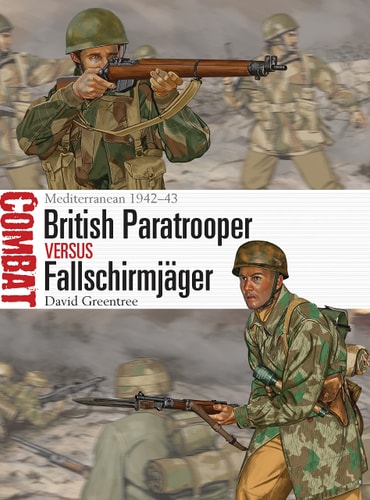
British Paratrooper vs Fallschirmjäger Mediterranean 1942–43
0
0
As an Amazon Associate and affiliate partner, Menrva Books earns from qualifying purchases. Learn more
Author Description
By late 1942 Britain had developed an airborne capability that would obtain its baptism of fire versus German airborne in North Africa and Sicily. On three notable occasions British airborne infantry fought intense battles with its German counterpart: twice in North Africa and again at Primosole Bridge in Sicily. Both forces were well trained and equipped, with a similar ethos and role, both thought of themselves as elite units, and both found themselves used by local commanders in a variety of roles that tended to be determined by the emergencies of the moment. On 29 November 1942 Lt Col Frost's 2nd Para dropped at Depienne, Tunisia, with orders to march overnight to Oudna, destroy the aircraft there and then return to Allied lines. Finding no aircraft they retreated, repeatedly combating elements of Oberst Koch's FJR 5, deployed in a ground role. 2nd Para ambushed and drove back Fallschirmjäger riding on armoured cars. Nearly surrounded, Frost withdrew to a nearby hill; a battle ensued as both sides raced for the crest. After retreating overnight 2nd Para wiped out an attacking German platoon, and on 3 December Frost's men finally reached Allied lines; all told, they had made five night marches and fought three battles, in total covering 50 miles, and only 180 of Frost's 450 men remained effective. Fighting as infantry, elements of 3rd Para encountered two companies of Fallschirmjäger-Pionier Bataillon, supported by elements of armour and artillery, in a strongly fortified position at Djebel Azag. On the night of 4/5 January 1943 a see-saw battle took place as the hill changed hands. The Germans were able to retain this key position. After weeks of further bitter fighting the British parachute brigade was again pulled out of the line in March 1943, but there would be no respite for any of the German parachute units; in May nearly all of those who had survived became POWs. On the night of 13/14 July 1943, 1st Para Brigade dropped to seize th
Menrva's Summary
THE THESIS
This book investigates the initial engagements between British paratroopers and German Fallschirmjäger in the Mediterranean theater during 1942-43, focusing on their baptism of fire and evolving roles. It examines how both elite airborne units, despite similar training and ethos, were frequently deployed in ground roles dictated by battlefield emergencies, leading to intense and often brutal clashes. The narrative details specific battles and the tactical decisions made by commanders on both sides, highlighting the high cost of these engagements for the paratroopers involved.
THE SCOPE MAP
- Detailed accounts of British airborne operations against German paratroopers in North Africa and Sicily between 1942 and 1943.
- Analysis of the initial deployment and combat experiences of British airborne forces, including the 2nd and 3rd Parachute Battalions.
- Examination of key battles such as Depienne, Oudna, Djebel Azag, and Primosole Bridge.
- Discussion of the tactical employment of both British and German airborne units in ground combat roles.
- Insights into the ethos and self-perception of these elite units.
- Information on the equipment and training of both forces.
- The consequences of these engagements for the surviving personnel.
THE AUTHORITY PERSPECTIVE
This work is recognized for its detailed examination of early airborne combat in the Mediterranean theater, providing a focused comparison of British paratroopers and German Fallschirmjäger. The author's analysis of the tactical situations and the often improvised roles assigned to these elite units offers valuable insight into the realities of World War II combat. It is a specialized study that appeals to historians and enthusiasts of airborne warfare, detailing specific engagements and their outcomes.
Page Count:
80
Publication Date:
2013-09-17
Publisher:
Bloomsbury USA
ISBN-10:
1780969244
ISBN-13:
9781780969244
History
Non-Fiction
European Theater
Military History
Community Tags
Similar Books