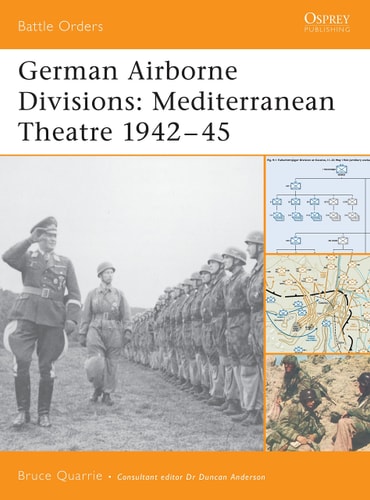
German Airborne Divisions Mediterranean Theatre 1942–45
0
0
As an Amazon Associate and affiliate partner, Menrva Books earns from qualifying purchases. Learn more
Author Description
Following the battle for Crete in May 1941, Hitler refused to undertake any further large-scale airborne operations due to the high casualty rate. The Fallschirmjäger subsequently took up a new role as elite 'line' infantry, and they served in the Mediterranean from 1942 to 1945, taking part in the conflict in North Africa, Sicily and Italy. Their performance in such hard-fought battles as El Alamein and Monte Cassino reinforced their reputation as some of the toughest troops of World War II. This book explores their changing role in organisation, training and doctrine as the paratroopers developed into Germany's finest frontline soldiers.
Menrva's Summary
THE THESIS
This book examines the evolution and combat performance of German airborne divisions in the Mediterranean Theatre from 1942 to 1945. Following their costly involvement in the Battle of Crete, Hitler curtailed large-scale airborne assaults, leading the Fallschirmjäger to transition into elite infantry units. This work details their new organizational structures, training regimens, and evolving doctrines as they fought in North Africa, Sicily, and Italy, solidifying their status as formidable frontline soldiers.
THE SCOPE MAP
- The shift in role for German paratroopers from airborne assault to elite infantry.
- Detailed accounts of their participation in key Mediterranean campaigns, including North Africa, Sicily, and Italy.
- Analysis of their involvement in significant battles such as El Alamein and Monte Cassino.
- Exploration of their changing organization, training, and doctrine throughout the period.
- Discussion of how they developed into Germany's finest frontline soldiers.
THE AUTHORITY PERSPECTIVE
The book details the transformation of German airborne divisions into elite line infantry after 1941, focusing on their Mediterranean service from 1942-1945. It highlights their roles in North Africa, Sicily, and Italy, and their performance in battles like El Alamein and Monte Cassino. The work aims to explore the development of their organization, training, and doctrine. The subject matter points to a detailed historical account for enthusiasts of World War II military operations.
Page Count:
96
Publication Date:
2005-10-10
Publisher:
Bloomsbury USA
ISBN-10:
1841768286
ISBN-13:
9781841768281
Non-Fiction
History
Military History
European Theater
Community Tags
Similar Books