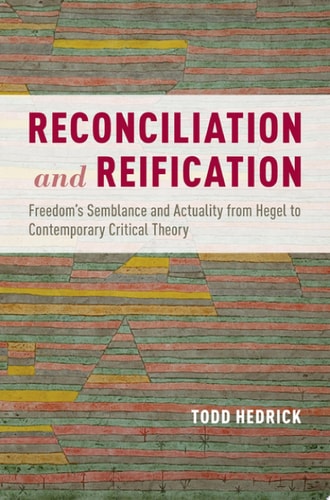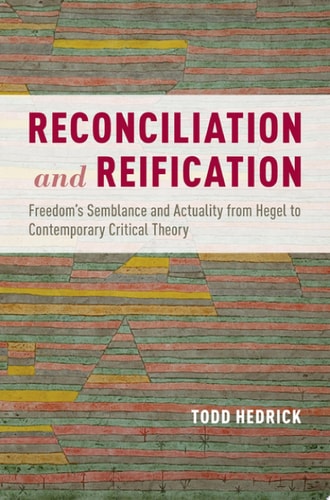
Reconciliation and Reification
0
0
As an Amazon Associate and affiliate partner, Menrva Books earns from qualifying purchases. Learn more
Author Description
The Critical Theory Tradition Has, Since Its Inception, Sought To Distinguish Its Perspective On Society By Maintaining That Persons Have A Deep-seated Interest In The Free Development Of Their Personality--an Interest That Can Only Be Realized In And Through The Rational Organization Of Society, But Which Is Systematically Stymied By Existing Society. And Yet Tradition Has Struggled To Specify This Emancipatory Interest In A Way That Is Neither Excessively Utopian Nor Accommodating To Existing Society. Despite The Fact That Hegel's Concept Of Reconciliation Is Normally Thought To Run Aground On The Latter Horn Of This Dilemma, This Book Argues That Reconciliation Is The Best Available Conceptualization Of Emancipatory Interest. Todd Hedrick Presents Hegel's Idea Of Freedom As Something Actualized In Individuals' Lives Through Their Reconciliation With How Society Shapes Their Roles, Prospects, And Sense Of Self; It Presents Reconciliation As Less A Matter Of Philosophical Cognition, And More Of Inclusion In A Responsive, Transparent Political Process. Hedrick Further Introduces The Concept Of Reification, Which--through Its Development In Marx And Lukács, Through Horkheimer And Adorno--substantiates An Increasingly Cogent Critique Of Reconciliation As Something Unachievable Within The Framework Of Modern Society, As Social Forces That Shape Our Identities And Life Prospects Come To Appear Natural, As Part Of The Way Things Just Are. Giving Equal Weight To Psychoanalysis And Legal Theory, This Work Critically Appraises The Writings Of Rawls, Honneth, And Habermas As Efforts To Spell Out A Reconciliation More Democratic And Inclusive Than Hegel's, Yet Still Sensitive To The Reifying Effects Of Legal Systems That Have Become Autonomous And Anonymous.
Menrva's Summary
THE THESIS
This book investigates whether the Hegelian concept of reconciliation can serve as a viable framework for understanding emancipatory interest in modern society without succumbing to utopianism or status quo accommodation. Todd Hedrick, a scholar of political and social philosophy, evaluates the tension between individual freedom and the structural constraints of society. By synthesizing historical philosophical concepts with contemporary political theory, he argues that reconciliation, when properly understood as inclusion in a responsive political process, remains the most effective conceptual tool for addressing the systematic stymieing of human development.
THE SCOPE MAP
What You Will Find
- A historical analysis of the concept of reconciliation from Hegel to modern critical theorists.
- An examination of reification as developed by Marx, Lukács, Horkheimer, and Adorno.
- A critical appraisal of the works of John Rawls, Axel Honneth, and Jürgen Habermas.
- An interdisciplinary approach integrating psychoanalysis and legal theory.
Scope Limits
- The text does not provide a practical policy manual for political reform.
- It does not offer a comprehensive history of all branches of 20th-century critical theory.
THE AUTHORITY PERSPECTIVE
Scholars and students of political philosophy frequently note the high level of academic density and rigorous conceptual analysis present in this work. Experts highlight it as a significant contribution to the ongoing debate regarding the compatibility of Hegelian reconciliation with modern democratic and legal frameworks.
Page Count:
336
Publication Date:
2018-01-01
Publisher:
Oxford University Press
ISBN-10:
0190634030
ISBN-13:
9780190634032
Philosophy
Social Philosophy
Political Theory
Critical Theory
Community Tags
Similar Books