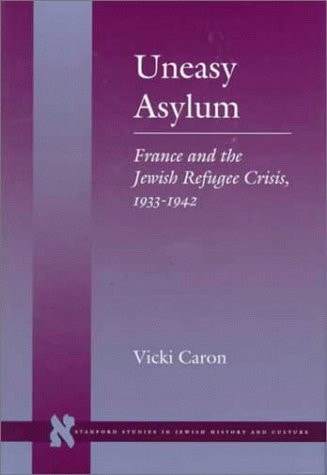
Uneasy Asylum: France and the Jewish Refugee Crisis, 1933-1942
0
0
As an Amazon Associate and affiliate partner, Menrva Books earns from qualifying purchases. Learn more
Author Description
This book, which draws on a rich array of primary sources and archival materials, offers the first major appraisal of French responses to the Jewish refugee crisis after the Nazi seizure of power in 1933. It explores French policies and attitudes toward Jewish refugees from three interrelated vantage points: government policy, public opinion, and the role of the French Jewish community. The author demonstrates that Jewish refugees in France were not treated in the same manner as other foreigners, in part because of foreign policy considerations and in part because Jewish refugees had a distinctive socioeconomic profile. By examining the socioeconomic and political factors that informed French refugee policy in the 1930's, the author presents overwhelming evidence that Vichy's anti-Jewish measures were not merely the work of a few antisemitic zealots in the administration, nor did they stem solely from the desire of Marshal Pétain's government to find scapegoats for the military defeat of 1940. Rather, they enjoyed widespread popular support, not only from far-right organizations but also from a host of middle-class professional associations and their members (doctors, lawyers, merchants, and artisans) who perceived Jews as a competitive threat. The author also sheds new light on Jewish political behavior in the 1930s. She demonstrates that the French Jewish community was sharply divided over the proper approach to the refugee crisis. While some Jewish leaders pressed for a hard-line policy, others worked assiduously to provide the refugees relief and to persuade the government to pursue a more liberal refugee policy. Thus the author refutes claims that the native French Jewish elite was overwhelmingly unsympathetic to the refugees because of fear that an influx of refugees would provoke an antisemitic backlash. While this book reveals the extent to which anti-refugee attitudes and policies in the 1930's paved the way for Vichy's anti-Jewish poli
Menrva's Summary
THE THESIS
This book investigates the complex and often contradictory French responses to the influx of Jewish refugees fleeing Nazi persecution between 1933 and 1942. It examines French policies and attitudes from the perspectives of the government, public opinion, and the French Jewish community itself. The author, Vicki Caron, a historian specializing in modern Jewish history, utilizes extensive primary sources and archival materials to demonstrate that French policies toward Jewish refugees were shaped by foreign policy considerations and the refugees' distinct socioeconomic profile, differentiating them from other foreign nationals. The work argues that the widespread support for Vichy's anti-Jewish measures stemmed not just from a few zealots but from a significant portion of the middle and professional classes who viewed Jewish immigrants as economic competitors.
THE SCOPE MAP
- Analysis of French government policies regarding Jewish refugees from 1933 to 1942.
- Exploration of public opinion and its influence on refugee reception in France.
- Examination of the internal divisions within the French Jewish community regarding refugee aid and policy.
- Demonstration of how socioeconomic and political factors informed French refugee policy.
- Evidence presented to counter the notion that Vichy's anti-Jewish measures were solely the work of a few individuals or a reaction to military defeat.
- Discussion of the perception of Jewish refugees as an economic threat by various professional associations.
- Refutation of claims that the native French Jewish elite was uniformly unsympathetic to refugees.
THE AUTHORITY PERSPECTIVE
This scholarly work is recognized for its comprehensive appraisal of French responses to the Jewish refugee crisis, drawing on a rich array of primary sources. The book's detailed examination of government policy, public opinion, and the role of the French Jewish community provides a nuanced understanding of the period. It effectively argues that anti-refugee sentiments and policies in the 1930s laid the groundwork for Vichy's later actions, which enjoyed broader popular support than previously acknowledged. The author's analysis also sheds light on the internal debates and differing approaches within the French Jewish community itself.
Page Count:
605
Publication Date:
1999-01-01
Publisher:
Stanford University Press
ISBN-10:
0804733120
ISBN-13:
9780804733120
Non-Fiction
History
European History
Jewish Studies
Community Tags
Similar Books