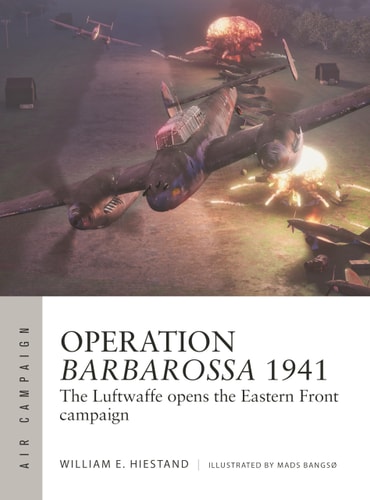
Operation Barbarossa 1941: The Luftwaffe Opens the Eastern Front Campaign
0
0
As an Amazon Associate and affiliate partner, Menrva Books earns from qualifying purchases. Learn more
Author Description
Barbarossa was the biggest German invasion of World War II. Comprehensively illustrated, this study explores the air campaign that spearheaded it, and how it evolved during the rest of 1941. The German invasion of the USSR, Operation Barbarossa, was the apex of Hitler's aggression. The strength of the Luftwaffe was gathered from across Europe for its opening strikes, where it faced a huge but badly equipped and ill-prepared Soviet Air Force (VVS) of 20,000 aircraft, which it quickly destroyed. In this book, Eastern Front expert William E. Hiestand examines this shattering first campaign, as well as how the Barbarossa air war developed over the following months. He describes how between June and December 1941, Luftwaffe losses rose and aircraft readiness steadily decreased under the pressure of combat. He also analyses the evacuation of Soviet industry – including aircraft production – to the Urals, and the rebuilding of the VVS; by the time German columns stalled 25km from Moscow, the VVS had more operational aircraft at the front than the Luftwaffe. He also covers aspects such as the abortive VVS strikes on Berlin and other strategic targets, and the Luftwaffe's strategic bombing raids on Moscow. With striking original artwork, 3D diagrams, maps and rare photos, this book reveals the full story of the aerial campaign in Barbarossa, as the devastation began in the most brutal theatre of World War II.
Menrva's Summary
THE THESIS
This book investigates the pivotal air campaign of Operation Barbarossa in 1941, examining how the Luftwaffe's initial dominance evolved under the immense pressures of the Eastern Front. As an expert on the Eastern Front, William E. Hiestand draws upon extensive historical data to analyze the shifting balance of power between the Luftwaffe and the rebuilt Soviet Air Force (VVS). The study details the rapid destruction of the Soviet air arm in the opening weeks, the subsequent rise in German losses, and the strategic implications of Soviet industrial evacuation and air force regeneration. Ultimately, it questions how the Luftwaffe's initial overwhelming success transformed into a struggle for air superiority by the end of the year.
THE SCOPE MAP
- The initial air superiority achieved by the Luftwaffe over the Soviet Air Force (VVS) in June 1941.
- Analysis of the VVS's rapid destruction, its vast but ill-equipped nature, and its subsequent rebuilding.
- Examination of the increasing Luftwaffe losses and decreasing aircraft readiness from June to December 1941.
- Details on the evacuation of Soviet industry, including aircraft production, to the Urals.
- Coverage of Soviet Air Force strikes on Berlin and other strategic targets.
- Analysis of Luftwaffe strategic bombing raids on Moscow.
- Inclusion of original artwork, 3D diagrams, maps, and rare photographs.
THE AUTHORITY PERSPECTIVE
This study by Eastern Front expert William E. Hiestand offers a comprehensive look at the air war during Operation Barbarossa, focusing on the critical period of 1941. The book is noted for its detailed examination of the Luftwaffe's initial overwhelming success against a poorly prepared Soviet Air Force, and how this dynamic shifted as the campaign progressed. It highlights the strategic importance of Soviet industrial relocation and the VVS's surprising resurgence, which challenged German air superiority by year's end. The inclusion of extensive visual aids and rare photographs promises a thorough account of this brutal aerial conflict.
Page Count:
96
Publication Date:
2024-09-10
Publisher:
Bloomsbury USA
ISBN-10:
1472861507
ISBN-13:
9781472861504
Non-Fiction
History
Military History
Aviation History
Eastern Front
Community Tags
Similar Books