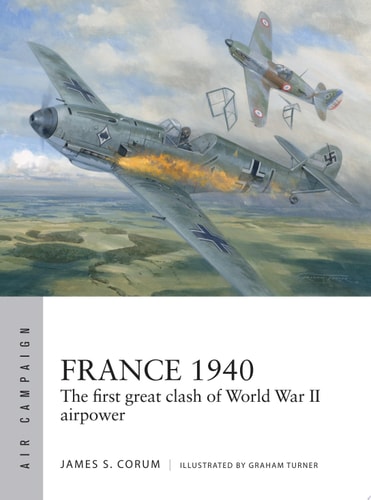
France 1940
0
0
As an Amazon Associate and affiliate partner, Menrva Books earns from qualifying purchases. Learn more
Author Description
A renowned airpower expert assesses the air campaign fought in France in 1940, explaining why the Luftwaffe was so effective against the French and British. The battle for France and Belgium was one of the most significant moments in modern warfare: the first great clash of modern major powers, where both sides possessed large and capable air forces, and modern combined-arms doctrine. It was in the air that the Germans had a notable advantage in both numbers and quality. But this does not fully explain the victory of the Luftwaffe over the RAF and the French Air Force in 1940. In this book, renowned airpower scholar James S. Corum offers an operational-level history of the air campaign, and explains comprehensively and concisely how the campaign was fought, and why the Luftwaffe made such superior use of their airpower. He explains the importance of the air forces' leadership and fighting doctrine, and aspects of the campaign often overlooked, such as the dysfunctional organization that kept hundreds of French aircraft out of the battle, and Germany's pioneering use of radio-equipped air liaison officers that provided the world's first system of 'on-call' close air support. Researched from French, British, and German primary sources, and illustrated throughout with artwork, 3D diagrams, maps and photos, this book distils the author's decades of scholarship into an essential guide to airpower in the fall of France.
Menrva's Summary
THE THESIS
of this book is that the Luftwaffe's decisive victory over Allied air forces in the 1940 Battle of France was due not only to German numerical and qualitative advantages in aircraft, but crucially to superior leadership, doctrine, and innovative operational tactics.** James S. Corum, a distinguished airpower scholar, meticulously details the air campaign using French, British, and German primary sources. The book examines the operational-level history, highlighting overlooked factors such as the disorganization of French air assets and Germany's pioneering use of radio-equipped air liaison officers for close air support. Corum argues that these elements, combined with effective airpower utilization, were key to the Luftwaffe's success.
THE SCOPE MAP
- An operational-level history of the air campaign in France, 1940.
- Analysis of the Luftwaffe's advantages in numbers, quality, leadership, and fighting doctrine.
- Examination of overlooked factors, including French organizational dysfunctions and German close air support innovations.
- Detailed use of French, British, and German primary sources.
- Illustrations including artwork, 3D diagrams, maps, and photographs.
THE AUTHORITY PERSPECTIVE
The book is presented as an essential guide to airpower in the fall of France, distilling decades of scholarship from a renowned airpower expert. Its comprehensive and concise explanation of the air campaign's conduct and the Luftwaffe's superior use of airpower suggests it aims to provide a definitive analysis for students of military history and aviation. The inclusion of primary sources and detailed illustrations indicates a thorough and authoritative approach to the subject matter.
Page Count:
96
Publication Date:
2025-04-24
Publisher:
Bloomsbury UK
ISBN-10:
1472864816
ISBN-13:
9781472864819
History
Non-Fiction
Military History
Aviation History
European History
Community Tags
Similar Books