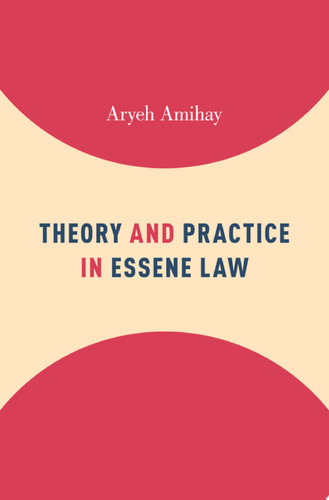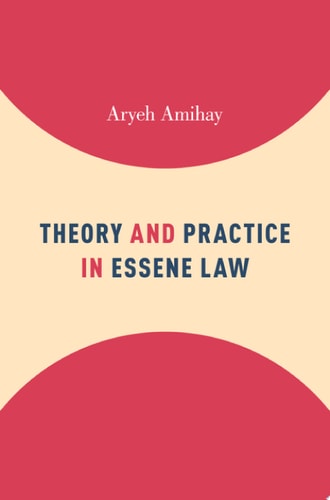
Theory and Practice in Essene Law
0
0
As an Amazon Associate and affiliate partner, Menrva Books earns from qualifying purchases. Learn more
Author Description
This book offers a novel approach for the study of law in the Judean Desert Scrolls, using the prism of legal theory. Following a couple of decades of scholarly consensus withdrawing from the "Essene hypothesis," it proposes to revive the term, and suggests employing it for the sectarian movement as a whole, while considering the group that lived in Qumran as the Yahad. It further proposes a new suggestion for the emergence of the Yahad, based on the roles of the Examiner and the Instructor in the two major legal codes, the Damascus Document and the Community Rule.The understanding of Essene law is divided into concepts and practices, in order to emphasize the discrepancy between creed, rhetoric, and practices. The abstract exploration of notions such as time, space, obligation, intention, and retribution, is then compared against the realities of social practices, including admission, initiation, covenant, leadership, reproof, and punishment.The legal analysis yields several new suggestions for the study of the scrolls: first, Amihay proposes to rename the two strands of thought of Jewish law, formerly referred to as "nominalism" and "realism," with the terms "legal essentialism" and "legal formalism." The two laws of admission in the Community Rule are distinguished as two different laws, one of an association for a group as a whole, the other as an admission of an individual. The law of reproof is proven to be an independent legal procedure, rather than a preliminary stage of prosecution. The methodological division in this study of thought and practice provides a nuanced approach for the study of law in general, and religious law in particular.
Menrva's Summary
THE THESIS
This book investigates the legal framework of the Judean Desert Scrolls by applying modern legal theory to the practices and creeds of the sectarian movement known as the Essenes. Aryeh Amihay, a scholar of ancient Jewish law, utilizes a methodological split between abstract legal concepts and concrete social practices to re-evaluate the sectarian identity of the Yahad. By analyzing the roles of the Examiner and the Instructor within the Damascus Document and the Community Rule, the author presents a revised understanding of how these groups established and maintained their legal order.
THE SCOPE MAP
What You Will Find
- A re-evaluation of the Essene hypothesis regarding the Qumran community.
- A comparative analysis of legal essentialism versus legal formalism in Jewish law.
- Detailed examinations of admission, initiation, covenant, and punishment procedures.
Scope Limits
- The study focuses primarily on the legal codes found within the Damascus Document and the Community Rule.
- It does not provide a comprehensive history of all Second Temple period sects outside of the specific Yahad movement.
THE AUTHORITY PERSPECTIVE
Scholars in the field of Qumran studies recognize this work as a significant methodological shift in how legal texts from the Judean Desert are interpreted. Readers frequently note the academic density of the prose, which is intended for researchers and students of ancient religious law.
Page Count:
258
Publication Date:
2016-01-01
Publisher:
Oxford University Press
ISBN-10:
0190631031
ISBN-13:
9780190631031
History
Religion
Judaism
Legal Theory
Essenes
Academic
Dead Sea Scrolls
Jewish law