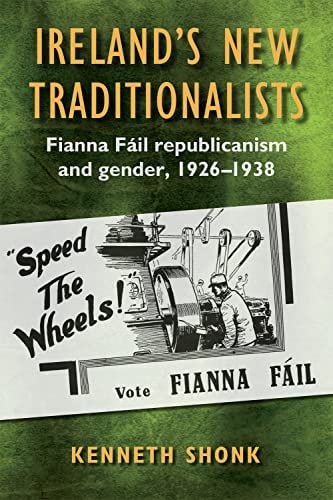
Ireland's New Traditionalists: Fianna Fáil, Republicanism and Gender, 1926-1938
0
0
As an Amazon Associate and affiliate partner, Menrva Books earns from qualifying purchases. Learn more
Author Description
The creation of Fianna Fáil in 1926 marked a new era in Irish politics wherein an evolved version of Irish republicanism, suited to operate in the Irish Free State, entered the political arena. Fianna Fáil was indeed a political organisation, but it was also a nationalist project, intent on creating a wide-reaching electorate and shaping Ireland's political discourse. De Valera's party defied the moribund direction of Irish republicanism, reversing the trend to the extent that the movement ultimately triumphed with the passage of the 1937 Bunreacht na hÉireann (Constitution of Ireland) and the Éire Confirmation Bill of 1938. Ireland's New Traditionalists situates Fianna Fáil's nationalist republican project within a broader European context by analysing the republican aesthetic through the lens of gender theory as well as situating Ireland within the context of interwar Europe. This analytical approach reveals that Fianna Fáil--the party that 'made' the modern Irish Republic--spent a great deal of time and energy in building a national discourse rooted in a male/female binary that served to 'correct' short term crises and long-term traumas by fabricating versions of an idealised Irish Feminine and Masculine that served to embody the party's vision of a traditionalist, yet modern Ireland.
Menrva's Summary
THE THESIS
This book investigates how Fianna Fáil, a pivotal Irish political party, constructed a nationalist republican identity rooted in gendered ideals during a transformative period in Irish history. The creation of Fianna Fáil in 1926 signaled a new phase for Irish republicanism, adapting it for the Irish Free State. Beyond its political function, the party pursued a nationalist agenda to shape public discourse and electoral participation. This work analyzes Fianna Fáil's republican aesthetic through the lens of gender theory, situating it within the broader context of interwar Europe to reveal how the party built a national narrative based on a male/female binary.
THE SCOPE MAP
- The evolution of Irish republicanism and the formation of Fianna Fáil.
- Analysis of Fianna Fáil's nationalist project within a European context.
- Application of gender theory to understand the republican aesthetic.
- Examination of the construction of idealized Irish Feminine and Masculine archetypes.
- The role of gendered discourse in addressing national crises and traumas.
- The party's vision of a traditionalist yet modern Ireland.
THE AUTHORITY PERSPECTIVE
The book situates Fianna Fáil's nationalist republican project within a broader European context, analyzing the republican aesthetic through the lens of gender theory. This approach reveals how the party constructed a national discourse rooted in a male/female binary. This binary served to 'correct' short-term crises and long-term traumas by fabricating versions of an idealized Irish Feminine and Masculine. These archetypes embodied the party's vision of a traditionalist, yet modern Ireland.
Page Count:
228
Publication Date:
2021-01-01
Publisher:
Cork University Press
ISBN-10:
1782054391
ISBN-13:
9781782054399
History
Non-Fiction
Nationalism
Irish History
Gender Studies
Community Tags
Similar Books