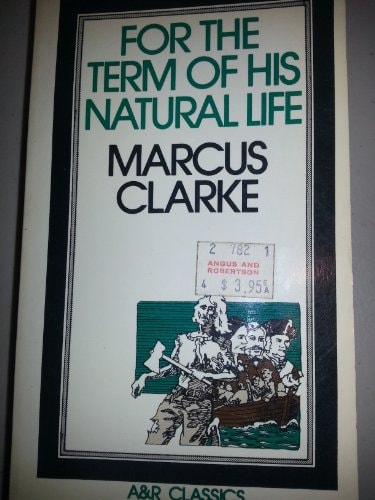
For the Term of His Natural Life
0
0
As an Amazon Associate and affiliate partner, Menrva Books earns from qualifying purchases. Learn more
Author Description
For the Term of His Natural Life is a novel by by Marcus Clarke, was published in 1872 (as His Natural Life)... Plot Summary: The story starts with a prologue, telling the tale of young British aristocrat, Richard Devine, who is the son of a shipbuilding magnate, Sir Richard Devine. In an incidence of domestic violence, Richard's mother reveals to Sir Richard that his son was fathered by another man, Lord Bellasis. Sir Richard proceeds to threaten the mother's reputation if Richard does not leave and never come back. He leaves him to pack for a while, claiming that he will fetch his lawyer to alter his will so that Richard receives no inheritance. When Richard leaves, he comes across a murder scene: his biological father, Lord Bellasis has been murdered, and Richard witnesses Sir Richard walking away from the scene of the crime. The police come and lock up Richard, who now gives his name as Rufus Dawes (which is used for the remainder of the book), for the murder of Lord Bellasis. Additionally, Sir Richard returns home and dies straight away, possibly of a heart-attack, without altering his will. Rufus Dawes/Richard Devine never finds this out. Rufus is found not guilty of the murder but guilty of the robbery of the corpse and sentenced to transportation to the penal colony of Australia. In 1827, Dawes is shipped to Van Diemen's Land on the Malabar, which also carries Captain Vickers, who is to become the new commander of the penal settlement at Macquarie Harbour, his wife Julia and child Sylvia, Julia's maid, one Sarah Purfoy and Lieutenant Maurice Frere, Richard Devine's cousin, son of Sir Richard's sister, who would have inherited the fortune in Richard's place.
Menrva's Summary
THE PULSE
Wrongfully convicted of a crime he did not commit, Richard Devine—now known as Rufus Dawes—must endure the brutal reality of life within the Australian penal system. Stripped of his identity and inheritance, Dawes faces a relentless cycle of physical hardship and systemic cruelty while navigating the treacherous social hierarchy of the penal colony. His struggle is compounded by the presence of his cousin, Maurice Frere, whose ambition and malice serve as a constant threat to his survival. The narrative unfolds as a grim examination of human endurance against the backdrop of nineteenth-century colonial injustice.
INSIDE THE PAGES
- Detailed depiction of the harsh conditions within the Van Diemen's Land penal settlement.
- Exploration of the theme of identity loss and the struggle for personal redemption.
- Use of a prologue to establish the inciting incident of the protagonist's false conviction.
- Examination of the corruption and moral decay inherent in the colonial penal system.
- Complex character dynamics involving the interplay between the protagonist and his antagonist cousin.
- Realistic portrayal of the social and political structures of 19th-century Australia.
- Incorporation of elements of the Victorian novel tradition adapted to a colonial setting.
- Focus on the psychological toll of long-term imprisonment and social isolation.
THE COLLECTIVE ECHO
This novel remains a foundational text in Australian literature, widely recognized for its unflinching portrayal of the convict era. Critics and readers alike have long noted the work's grim realism and its significant impact on the national consciousness regarding colonial history. The narrative's intensity and its focus on the systemic failures of the penal system continue to draw scholarly attention and analysis. It is frequently cited as a definitive example of the nineteenth-century novel's capacity to critique social institutions through the lens of individual suffering.
Page Count:
445
Publication Date:
1872-01-01
Publisher:
Angus & Robertson
ISBN-10:
020713250X
ISBN-13:
9780207132506
Crime
Drama
Historical Fiction
Prisoners transportation of
Prisoners
Penal Colonies
Classic Literature
Australian
Australia
Community Tags
Other Editions(3)


Similar Books







Reader Comments
Share Your Thoughts
No comments yet. Be the first to share your thoughts!