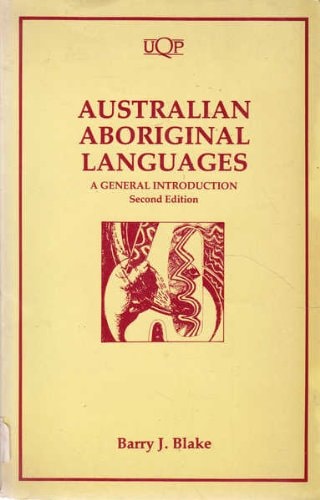
Australian Aboriginal Languages
0
0
As an Amazon Associate and affiliate partner, Menrva Books earns from qualifying purchases. Learn more
Author Description
This study covers a number of topics that are prominent in the grammars of Australian Aboriginal languages, especially ergativity and manifestations of the hierarchy that runs from the speech-act participants down to inanimates. This hierarchy shows up in case marking, number marking and agreement, advancement and cross-referencing. Chapter 1 provides an overall picture of Australian languages. Chapters 2, 3 and 4 deal with case systems, including voice alternations and other advancements. Chapter 5 deals with the distribution of case marking within the noun phrase. Chapter 6 deals with systems that allow the cross-referencing of bound pronouns. Chapter 7 deals with clauses which appear to have more than one verb. Chapter 8 deals with compound and complex sentences. Chapter 9 deals with word order, and emphasises a theme introduced in Chapter 5, namely the widespread use of discontinuous phrases. Chapter 10 draws together ergativity and various manifestations of the hierarchy, and attempts to interpret their distribution. The final section provides an interesting hypothesis about the evolution of core grammar in Australia.
Menrva's Summary
THE THESIS
This study investigates the structural commonalities and grammatical complexities inherent in Australian Aboriginal languages, specifically focusing on ergativity and the hierarchy of speech-act participants. Barry J. Blake, a noted linguist, utilizes comparative data from numerous indigenous languages to analyze how case marking, agreement systems, and clause structures function within this unique linguistic landscape. The work provides a systematic framework for understanding how these languages organize information and manage syntactic relationships.
THE SCOPE MAP
What You Will Find
- Analysis of ergativity and its role in case marking systems.
- Examination of the hierarchy ranging from speech-act participants to inanimates.
- Detailed study of discontinuous phrases and word order patterns.
- Investigation into clause structures, including multi-verb clauses and complex sentences.
- A hypothesis regarding the evolutionary development of core grammar in Australia.
THE AUTHORITY PERSPECTIVE
This text is regarded as a foundational resource for scholars and students of Australian linguistics due to its rigorous technical analysis of grammatical phenomena. The systematic approach provides a clear, albeit dense, overview of the syntactic mechanisms that define these language families.
Page Count:
137
Publication Date:
1981-01-01
Publisher:
Angus & Robertson
ISBN-10:
0207141509
ISBN-13:
9780207141508
Reference
Anthropology
Grammar
Linguistics
Community Tags
Similar Books