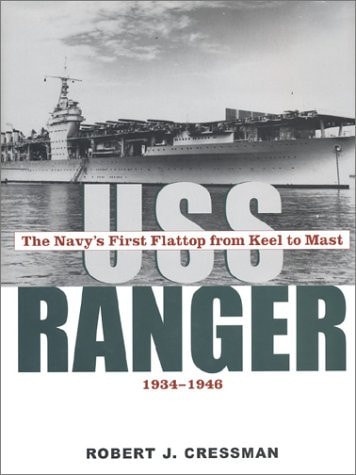
USS Ranger: The Navy's First Flattop from Keel to Mast, 1934-46
0
0
As an Amazon Associate and affiliate partner, Menrva Books earns from qualifying purchases. Learn more
Author Description
USS Ranger (CV-4) was the U.S. Navy’s first aircraft carrier to be built as such from the keel up. The Ranger helped maintain the Franklin D. Roosevelt administration’s Good Neighbor Policy, served as a platform for the development of new methods for the operation of carriers and carrier aircraft, continued the Navy’s work in cold-weather flight operations, pioneered director-controlled antiaircraft fire, and trained many naval aviators. During World War II, the Ranger occupied center stage in Operation Torch (against the Vichy French positions in North Africa in 1942) and Operation Leader (against German shipping in 1943), which was the Navy’s only carrier operation above the Arctic Circle during the war. In both instances, the ship’s air group faced the requirement to hit legitimate military targets while minimizing civilian casualties, a problem the United States would confront again in later conflicts. Robert J. Cressman’s emphasis on the human element in both peace and war reinforces his observation that carriers, like people, have multifaceted personalities, represented by not only the ship and its company, but also the air group for which it serves as home.
Menrva's Summary
THE THESIS
The USS Ranger, America's first purpose-built aircraft carrier, played a pivotal role in shaping naval aviation and engaging in critical wartime operations. Commissioned in 1934, the Ranger served as a testbed for new carrier operational methods and cold-weather flight techniques, while also pioneering advancements in anti-aircraft fire control. Its wartime service included significant roles in Operation Torch in North Africa and Operation Leader, a unique carrier operation above the Arctic Circle, where its air group faced the challenge of striking military targets while minimizing civilian casualties. The book explores the multifaceted personality of the carrier, encompassing its ship and crew, as well as the air group it supported.
THE SCOPE MAP
- Detailed account of the USS Ranger's construction and early development as the U.S. Navy's first purpose-built aircraft carrier.
- Analysis of the Ranger's contributions to the Good Neighbor Policy and its role in developing new operational methods for carriers and aircraft.
- Exploration of the Navy's cold-weather flight operations and the pioneering of director-controlled anti-aircraft fire.
- In-depth coverage of the Ranger's involvement in Operation Torch (North Africa, 1942) and Operation Leader (Arctic Circle, 1943).
- Discussion of the challenges faced by the air group in minimizing civilian casualties during combat operations.
- Examination of the human element, portraying the carrier, its company, and its air group as having distinct personalities.
THE AUTHORITY PERSPECTIVE
This comprehensive history of the USS Ranger is recognized for its detailed examination of the ship's pioneering role in naval aviation and its significant wartime contributions. The author's focus on the human element, alongside the technical and operational aspects, provides a nuanced perspective on the carrier's multifaceted identity. The book is valued for its thorough research into key operations like Torch and Leader, highlighting the strategic and ethical considerations faced by its crew.
Page Count:
408
Publication Date:
2004-01-01
Publisher:
University of North Carolina Press
ISBN-10:
1574887203
ISBN-13:
9781574887204
Non-Fiction
History
Aviation History
Naval history
Military History
Community Tags
Similar Books