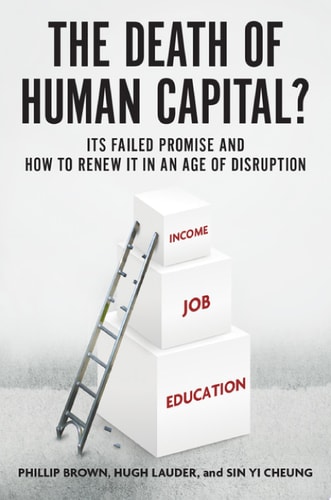
The Death of Human Capital?
0
0
As an Amazon Associate and affiliate partner, Menrva Books earns from qualifying purchases. Learn more
Author Description
Human Capital Theory, Or The Notion That There Is A Direct Relationship Between Educational Investment And Individual And National Prosperity, Has Dominated Public Policy On Education And Labor For The Past Fifty Years. In The Death Of Human Capital?, Phillip Brown, Hugh Lauder, And Sin Yi Cheung Argue That The Human Capital Story Is One Of False Promise: Investing In Learning Isn't The Road To Higher Earnings And National Prosperity. Rather Than Abandoning Human Capital Theory, However, The Authors Redefine Human Capital In An Age Of Smart Machines. They Present A New Human Capital Theory That Rejects The View That Automation And Ai Will Result In The End Of Waged Work, But See The Fundamental Problem As A Lack Of Quality Jobs Offering Interesting, Worthwhile, And Rewarding Opportunities. A Controversial Challenge To The Reigning Ideology, The Death Of Human Capital? Connects With A Growing Sense That Capitalism Is In Crisis, Felt By Students And The Wider Workforce, Shows What's At Stake In The New Human Capital While Offering Hope For The Future.
Menrva's Summary
THE THESIS
Does the long-standing correlation between educational investment and economic prosperity remain valid in an era defined by automation and artificial intelligence? The authors, a team of scholars specializing in education and labor markets, analyze the historical failure of Human Capital Theory to deliver on its promises of widespread prosperity. They propose a redefined framework that shifts the focus from individual skill acquisition to the systemic scarcity of high-quality, meaningful employment in a digital economy.
THE SCOPE MAP
What You Will Find
- A critical evaluation of fifty years of education and labor policy.
- A theoretical framework for human capital in the age of smart machines.
- Analysis of the relationship between technological advancement and the degradation of job quality.
Scope Limits
- The text does not provide a comprehensive technical manual for AI implementation.
- It does not offer a localized policy guide for specific national labor markets.
THE AUTHORITY PERSPECTIVE
Experts recognize this work as a significant critique of neoliberal educational ideology and its impact on modern labor markets. Readers frequently note the academic rigor of the authors' arguments and the clarity with which they connect macro-economic trends to the lived experience of the contemporary workforce.
Page Count:
224
Publication Date:
2020-01-01
Publisher:
Oxford University Press
ISBN-10:
019064432X
ISBN-13:
9780190644321
Economics
Labor Studies
Education Policy
Technology
Sociology
Community Tags
Similar Books