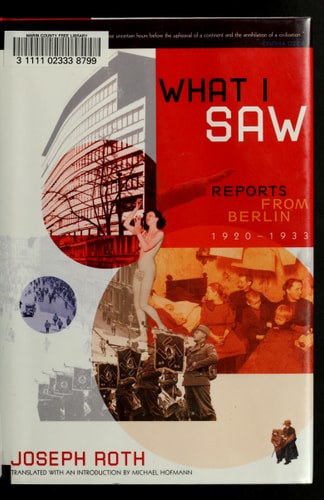
What I Saw: Reports from Berlin, 1920-1933
0
0
As an Amazon Associate and affiliate partner, Menrva Books earns from qualifying purchases. Learn more
Author Description
The Joseph Roth revival has finally gone mainstream with the thunderous reception for What I Saw, a book that has become a classic with five hardcover printings. Glowingly reviewed, What I Saw introduces a new generation to the genius of this tortured author with its "nonstop brilliance, irresistible charm and continuing relevance" (Jeffrey Eugenides, The New York Times Book Review). As if anticipating Christopher Isherwood, the book re-creates the tragicomic world of 1920s Berlin as seen by its greatest journalistic eyewitness. In 1920, Joseph Roth, the most renowned German correspondent of his age, arrived in Berlin, the capital of the Weimar Republic. He produced a series of impressionistic and political essays that influenced an entire generation of writers, including Thomas Mann and the young Christopher Isherwood. Translated and collected here for the first time, these pieces record the violent social and political paroxysms that constantly threatened to undo the fragile democracy that was the Weimar Republic. Roth, like no other German writer of his time, ventured beyond Berlin's official veneer to the heart of the city, chronicling the lives of its forgotten inhabitants: the war cripples, the Jewish immigrants from the Pale, the criminals, the bathhouse denizens, and the nameless dead who filled the morgues. Warning early on of the dangers posed by the Nazis, Roth evoked a landscape of moral bankruptcy and debauched beauty; a memorable portrait of a city and a time of commingled hope and chaos. What I Saw, like no other existing work, records the violent social and political paroxysms that compromised and ultimately destroyed the precarious democracy that was the Weimar Republic.
Menrva's Summary
THE THESIS
The book investigates the tumultuous social and political landscape of Berlin between 1920 and 1933 through the eyes of its preeminent journalistic observer. Joseph Roth, a renowned German correspondent, arrived in Berlin during the Weimar Republic and produced a series of essays capturing the city's vibrant yet volatile atmosphere. His writings documented the struggles of marginalized populations, the rise of political extremism, and the fragility of democracy. Roth's keen observations provided an early warning of the dangers posed by the burgeoning Nazi party, offering a prescient account of a society on the brink of collapse.
THE SCOPE MAP
- A collection of journalistic essays and impressionistic pieces by Joseph Roth.
- Chronicles of Berlin during the Weimar Republic (1920-1933).
- Analysis of the social and political paroxysms threatening German democracy.
- Portraits of forgotten inhabitants: war cripples, Jewish immigrants, criminals, and others.
- Early warnings and commentary on the rise of Nazism.
- Insights into the moral and cultural climate of 1920s and early 1930s Berlin.
- Essays that influenced contemporary writers like Thomas Mann and Christopher Isherwood.
THE AUTHORITY PERSPECTIVE
This collection has been lauded as a significant contribution to understanding Weimar Berlin, with reviewers highlighting Joseph Roth's genius as a journalistic eyewitness. The book is celebrated for its "nonstop brilliance, irresistible charm and continuing relevance," as noted by The New York Times Book Review. It is recognized for re-creating the tragicomic world of 1920s Berlin and for its prescient warnings about the dangers of Nazism. The essays are valued for their deep dive into the city's underbelly and their influence on subsequent generations of writers.
Page Count:
227
Publication Date:
2003-01-01
Publisher:
W. W. Norton & Company
ISBN-10:
0393051676
ISBN-13:
9780393051674
History
Non-Fiction
Germany
European History
Journalism
Social History
Political Commentary
Community Tags
Similar Books