
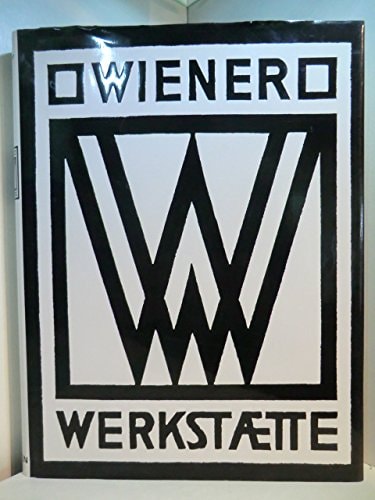
Wiener Werkstätte 1903-1932
0
0
As an Amazon Associate and affiliate partner, Menrva Books earns from qualifying purchases. Learn more
Author Description
The Wiener Werkstätte ("Vienna Workshop") bears many hallmarks of a modern creative movement. Founded in 1903 by Josef Hoffmann, Koloman Moser, and Fritz Waerndorfer, this progressive alliance of artists and designers was particularly interested in challenging industrialised society with individual handcraftsmanship, and in bringing different facets of life into one unified, elegant artwork. The workshop began life in three small rooms, but soon expanded to fill a three storey building with special departments for metalwork, leatherwork, and woodwork, as well as a book binder and a paint shop. Artists experimented with various materials such as gold, precious stones, and papier mâché and applied their simple, often geometric, designs across ceramics, textiles, typography, interior design, furniture, and fashion. In architectural commissions such as the Purkersdorf Sanatorium and the Palais Stoclet in Brussels, the group was able to realize its ideal of the Gesamtkunstwerk ("total artwork"), in which every detail of an environment was designed as an integral part of a coordinated whole. Though the workshop lasted only 30 years, it enjoyed major commercial success, with outlets in Karlsbad, Marienbad, Zurich, New York, and Berlin. It also garnered designs from many of the leading artists of the epoch, including Gustav Klimt, Oskar Kokoschka,and Egon Schiele. Today, the Vienna Workshop is recognized for its comprehensive approach to artistic practice and its stylistic influence on Art Deco and Bauhaus.
Menrva's Summary
THE THESIS
The Wiener Werkstätte emerged as a pivotal force in early 20th-century design, challenging industrial mass production with a commitment to individual craftsmanship and the concept of the Gesamtkunstwerk. Founded in 1903 by Josef Hoffmann, Koloman Moser, and Fritz Waerndorfer, this Viennese collective sought to unify all aspects of life into a cohesive artistic vision. The workshop expanded rapidly, encompassing departments for metalwork, leatherwork, woodwork, bookbinding, and painting, and artists experimented with diverse materials and applied their distinctive geometric designs across a wide range of media, from ceramics and textiles to furniture and fashion. Their influence extended to architectural commissions, realizing the ideal of a total artwork where every detail was integrated into a unified whole, and attracting contributions from prominent artists of the era.
THE SCOPE MAP
- The founding principles and early development of the Wiener Werkstätte.
- Detailed exploration of the workshop's various departments and the materials and techniques employed.
- Analysis of key design principles, including geometric forms and the concept of the Gesamtkunstwerk.
- Case studies of significant architectural and interior design projects.
- The workshop's commercial reach and international outlets.
- Contributions from notable artists associated with the movement, such as Gustav Klimt.
- The lasting stylistic influence on Art Deco and Bauhaus movements.
THE AUTHORITY PERSPECTIVE
This comprehensive survey of the Wiener Werkstätte is recognized for its detailed examination of a significant early 20th-century design movement. The book meticulously documents the workshop's origins, its commitment to handcraftsmanship against industrialization, and its realization of the Gesamtkunstwerk ideal. It highlights the diverse range of materials and applications, from fine metalwork to textiles and architecture, and acknowledges the contributions of prominent artists. The work is valued for its insight into the movement's lasting influence on subsequent design eras like Art Deco and Bauhaus.
Page Count:
240
Publication Date:
2015-01-01
Publisher:
Taschen
ISBN-10:
3836519887
ISBN-13:
9783836519885
Art
Non-Fiction
Modernism
Decorative Arts
Design
Art History
Community Tags
Other Editions(4)


Similar Books











Reader Comments
Share Your Thoughts
No comments yet. Be the first to share your thoughts!